
A Textbook of Historical Disinformation? A List of Factual Errors in the Textbook. Part II
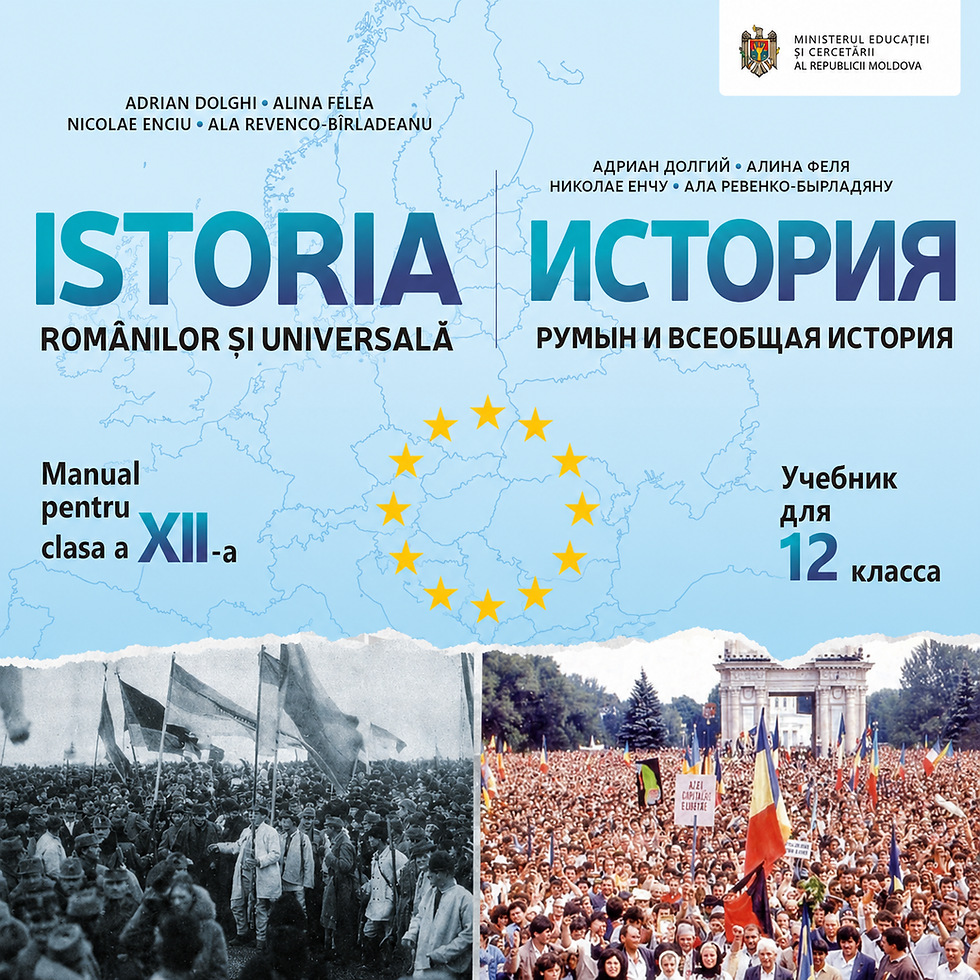
A Textbook of Historical Disinformation? A List of Factual Errors in the Textbook: Istoria românilor şi universală: Manual pentru clasa a 12-a / Adrian Dolghi, Alina Felea, Nicolae Enciu, Ala Revenco-Bîrladeanu; Ministerul Educaţiei şi Cercetării al Republicii Moldova. — [Chişinău]: Ştiinţa, 2024 (Combinatul Poligrafic). — 304 p.: il.
РУССКИЙ: Учебник исторической дезинформации? Список фактических ошибок учебника: История румын и всеобщая история
ROMÂNA: Un manual al dezinformării istorice? Lista erorilor factuale din manual: Istoria românilor şi universală
The Grade 12 textbook History of the Romanians, published in 2024 under the auspices of the Ministry of Education of the Republic of Moldova, has provoked widespread public criticism because of the authors' attempt to normalize the regime of Marshal Antonescu, Hitler's ally, and to marginalize the Romanian Holocaust, in which between 280,000 and 380,000 Jews and approximately 11,000 Roma were murdered.
The textbook received negative evaluations from the Yad Vashem Institute (Jerusalem) and the Elie Wiesel National Institute (Bucharest). The Jewish Community of the Republic of Moldova demanded that the textbook be withdrawn from use in schools and filed a lawsuit against the Ministry of Education.
The Minister of Education, Dan Perciun, has refused to comply with the Jewish Community's demand. On 15 May 2025, he stated that “at this stage, in the opinion of our country's leading historians, there are no problems with the textbook; the overall assessments are positive, while recommendations have been made on how it can be improved.”
The journal Historical Expertise has undertaken the initiative to demonstrate that the textbook is unacceptable not only on ideological grounds but also because it is riddled with serious factual errors. We identified 114 errors of this kind. Students who study from this textbook will not only acquire inaccurate knowledge about the past but may also receive unsatisfactory grades in their examinations.
We address the results of our expert review to everyone concerned with the quality of education in the schools of the Republic of Moldova: parents, teachers, politicians, public figures, and representatives of international organizations. We hope that, through our joint efforts, children will be protected from indoctrination based on an ideology that is questionable from the perspective of European values, coupled with a stream of factual errors that are inconceivable in a school textbook.
Serghei Erlih, PhD, Editor-in-Chief of the journal Historical Expertise;
Leonid Mosionzhnik, PhD;
Alexey Rusanov, Independent Researcher;
Mark Tkachuk, PhD, Member of Parliament of the Republic of Moldova
Alexei Tulbure, Director of Oral History Institute of Moldova
Raport final. Comisia Internaţională pentru Studierea Holocaustului în România. Raport final. Editori: Tuvia Friling, Radu Ioanid, Mihail E. Ionescu. Iaşi: Polirom, 2004. P. 178, 240. URL: https://www.inshr-ew.ro/wp-content/uploads/2026/05/Raport_final.pdf.pdf
Comments of Yad Vashem Experts, Dr. Arkady Zeltzer and Dr. Alexander Avraham, on the
Romanian and Universal History Textbook (12th Grade). URL: https://mec.gov.md/sites/default/files/expertixa_manual_de_istorie_yad_vashem.pdf
Manualul de Istorie de clasa a XII-a din Republica Moldova stârnește criticile comunității evreiești pentru felul „edulcorat” și „inadecvat” în care prezintă regimul Antonescu și elemente ale Holocaustului / Ministrul Dan Perciun: „Nu sunt lucruri dramatice” / Institutul Elie Wiesel insistă că este nevoie de reeditare și corecturi și acuză o „încremenire în proiect”. URL: https://www.edupedu.ro/manualul-de-istorie-de-clasa-a-xii-a-din-republica-moldova-starneste-criticile-comunitatii-evreiesti-pentru-felul-edulcorat-si-inadecvat-in-care-prezinta-regimul-an/
Statement of the Jewish Community of the Republic of Moldova regarding public reports about a meeting of the representatives of “Jewish youth” with the Minister of Education and Research of the Republic of Moldova. URL: https://jcm.md/en/statementof-the-jewish-community-of-the-republic-of-moldovaregarding-public-reports-about-a-meeting-of-the-representatives-of-jewish-youth-with-the-minister-of-education-and-research/
Ministerul Educației a primit răspuns de la Yad Vashem privind manualul de istorie pentru clasa a XII-a. „Multe sugestii acolo”URL: https://tv8.md/2025/05/15/video-ministerul-educatiei-a-primit-raspuns-de-la-yad-vashem-privind-manualul-de-istorie-pentru-clasa-a-xii-a-multe-sugestii-acolo/281577
Contents. Part I:
Illustrations: 9 errors
Chronology: 34 errors
Statistics and Other Quantitative Indicators: 15 errors
Definitions and Logical Inconsistencies: 22 errors
Contents. Part II:
Other: 32 errors
Nr. 83 P. 16: „Rusia a fost obligată să încheie Tratatul de la San-Stefano, prin care primea unele teritorii în Caucaz și Dobrogea”.
No. 83 P. 16: "Russia was compelled to conclude the Treaty of San Stefano, under which it received certain territories in the Caucasus and Dobruja."
No. 83 Correct answer: The assertion that Russia acquired Dobruja under the Treaty of San Stefano is incorrect. At San Stefano, Russia recovered Southern Bessarabia, which it had lost in 1856. Northern Dobruja, which had previously belonged to the Ottoman Empire, was to be transferred to Romania as compensation for the loss of Southern Bessarabia. The treaty states: “Not wishing to annex the aforementioned territory [Northern Dobruja] and the islands of the Delta, Russia reserves the right to exchange them for the part of Bessarabia detached from it under the Treaty of 1856” (Article 19).
Сан-Стефанский прелиминарный мирный договор. URL: https://www.hist.msu.ru/ER/Etext/FOREIGN/stefano.htm
Nr. 84 P. 19: „Totodată, Marea Britanie dorea capturarea coloniilor germane din Orientul Mijlociu, slăbirea Imperiului Otoman, divizarea acestuia și acapararea coloniilor lui”.
No. 84 P. 19: "At the same time, Great Britain sought to seize the German colonies in the Middle East, weaken the Ottoman Empire, partition it, and take possession of its colonies."
No. 84 Correct answer: Germany had no colonies in the Middle East.
Nr. 85 P. 43: „Germania, declarată principala responsabilă de declanșarea războiului, ceda Alsacia și Lorena în favoarea Franței, coridorul Danzigului, Silezia Superioară, sudul Prusiei Orientale şi regiunea Teschen — a Poloniei; Eupen şi Malmedy — a Belgiei etc.”
No. 85 P. 43: "Germany, declared principally responsible for the outbreak of the war, ceded Alsace and Lorraine to France; the Polish Corridor, Upper Silesia, southern East Prussia, and the Teschen region to Poland; Eupen and Malmedy to Belgium; and other territories as stipulated by the treaty."
No. 85 Correct answer: Prior to 1918, the Teschen (Cieszyn) region belonged not to Germany but to Austria-Hungary. After 1918, the region was divided between Poland and Czechoslovakia, which continued to dispute its ownership for many years.
Nr. 86 P. 58: „La 15 martie 1939, când trupele germane au ocupat Praga, președintele cehoslovac E. Beneș, care se opunea secesiunii Slovaciei, a fost obligat să „accepte“ intervenția germană.”
No. 86 P. 58: "On 15 March 1939, when German troops occupied Prague, Czechoslovak President Edvard Beneš, who opposed Slovakia’s secession, was compelled to ‘accept’ the German intervention."
No. 86 Correct answer: Edvard Beneš had resigned on 5 October 1938 and subsequently left the country.
Edvard Beneš https://en.wikipedia.org/wiki/Edvard_Bene%C5%A1
Nr. 87 P. 70: „Țările Baltice, conform Protocolului secret, au fost obiectul negocierilor între URSS și Germania, fiind stipulat faptul că Letonia și Estonia constituiau sfera de interes a URSS-ului, iar Lituania se afla în sfera de interes a ambelor state semnatare.”
No.87 P. 70: "Under the Secret Protocol, the Baltic states became the subject of negotiations between the USSR and Germany. It was stipulated that Latvia and Estonia would fall within the Soviet sphere of interest, whereas Lithuania would lie within the sphere of interest of both signatory states."
No. 87 Correct answer: According to Article 1 of the Secret Additional Protocol to the German-Soviet Non-Aggression Pact of 23 August 1939: "In the event of a territorial and political rearrangement of the areas belonging to the Baltic States (Finland, Estonia, Latvia, Lithuania), the northern boundary of Lithuania shall represent the boundary of the spheres of influence of Germany and the USSR. At the same time, the interests of Lithuania in relation to the Vilnius region are recognized by both parties." Thus, Lithuania initially lay exclusively within Germany's sphere of influence. The situation changed with the signing of the German-Soviet Treaty of Friendship and Frontier on 28 September 1939, which formalized the partition of Poland. A secret protocol signed together with that treaty transferred Lithuania into the Soviet sphere of influence. The remaining small portion of Lithuanian territory was transferred by Germany to the USSR under the protocol of 10 January 1941.
Secret Additional Protocol. URL: https://avalon.law.yale.edu/20th_century/addsepro.asp
German–Soviet Treaty of Friendship. URL: https://courses.lumenlearning.com/suny-worldhistory/chapter/31-3-2-german-soviet-treaty-of-friendship/
Nr. 88 P. 70: „După a doua notă ultimativă, rămasă fără sprijin occidental, deoarece Marea Britanie lupta cu Germania, iar Franța, la 22 iunie 1940, capitulase, Italia și Germania optau pentru satisfacerea cerințelor sovietice pentru evitarea unui război cu URSS, România a fost obligată să cedeze”
No. 88 P. 70: "Following the second ultimatum, and left without Western support—since Great Britain was at war with Germany and France had capitulated on 22 June 1940—while Italy and Germany favored accommodating the Soviet demands in order to avoid a war with the USSR, Romania was compelled to yield."
No. 88 Correct answer: Article 3 of the Secret Additional Protocol to the German-Soviet Non-Aggression Pact of 23 August 1939 states: "With regard to southeastern Europe, the Soviet side emphasizes its interest in Bessarabia. The German side declares its complete political disinterest in these territories." Consequently, in June 1940 the USSR acted in accordance with its agreements with Nazi Germany concerning the division of spheres of influence reached on 23 August 1939. Therefore, it is incorrect to claim that "Italy and Germany chose to satisfy Soviet demands in order to avoid war with the USSR."
Secret Additional Protocol. URL: https://avalon.law.yale.edu/20th_century/addsepro.asp
Nr. 89 P. 112–113: „Însă, la 12 martie 1940, a fost nevoită să semneze Tratatul de la Moscova, cedând mai multe teritorii, inclusiv Karelia”.
No. 89 P. 112–113: "However, on 12 March 1940, it was forced to sign the Treaty of Moscow, ceding several territories, including Karelia."
No. 89 Correct answer: Both the USSR (and subsequently the Russian Federation) and Finland have had, and continue to have, regions bearing the name "Karelia." The textbook's wording creates the false impression that Karelia did not exist within the USSR prior to 12 March 1940. Furthermore, under the Moscow Peace Treaty of 1940, not all of Finnish Karelia was ceded to the USSR. To avoid misleading students, the textbook should have referred specifically to the "Karelian Isthmus and the Northern Ladoga Region" and should also have mentioned the other Finnish territories transferred to the USSR under the 1940 Moscow Peace Treaty. The same error is repeated on p. 139.
Karelia (historical province). URL: https://en.wikipedia.org/wiki/Karelia_(historical_province)
Nr. 90 P. 113: „În conformitate cu Planul operației militare „Leul de Mare”, Germania nazistă a atacat Marea Britanie”.
No. 90 P. 113: "In accordance with the military operational plan ‘Operation Sea Lion,’ Nazi Germany attacked Great Britain."
No. 90 Correct answer: Germany never attacked Great Britain under Operation Sea Lion (Seelöwe). It was a planned but never executed amphibious invasion of Britain across the English Channel, prepared after the fall of France.
Liddell Hart B. H. History of the Second World War. London: Pan Books, 1970. P. 107, 146.
Nr. 91 P. 115: „După luni de lupte crâncene, Armata Sovietică a reușit să încercuiască și să determine capitularea Armatei a VI-a Germane, în frunte cu feldmareșalul von Paulus, cu 90 000 de prizonieri, fapt care a marcat un punct de cotitură radicală în cursul Celui de-Al Doilea Război Mondial”.
No. 91 P. 115: "After months of fierce fighting, the Soviet Army succeeded in encircling and compelling the surrender of the German Sixth Army, commanded by Field Marshal von Paulus, taking 90,000 prisoners. This marked a decisive turning point in the course of the Second World War."
No. 91 Correct answer: Paulus was not of noble birth. Therefore, the prefix "von" has been added to his name without justification.
Friedrich Paulus. URL: https://ww2db.com/person_bio.php?person_id=8
Nr. 92 P. 124: „El [Antonescu] a fost numit comandant al Grupului de Armate Sud, care cuprindea 20 de divizii și 9 brigăzi românești (armatele 1 și 4), majoritatea forțelor aeriene și navale ale României — în total 473 103 oameni, plus Armata a II-a Germană (6 divizii)”.
No. 92 P. 124: "He [Antonescu] was appointed commander of Army Group South, which comprised 20 Romanian divisions and 9 brigades (the First and Fourth Armies), the majority of Romania's air and naval forces—a total of 473,103 personnel—together with the German Second Army (six divisions)."
No. 92 Correct answer: There are three errors in a single sentence: (1) Army Group South was commanded at that time by the German Field Marshal Gerd von Rundstedt. Antonescu commanded a strategic grouping that is referred to in some sources as "General Antonescu"—the grouping of forces stationed in Romania before the invasion of the USSR. (2) the forces under Antonescu's command included the Romanian Third and Fourth Armies (not the First and Fourth) and (3) the grouping that attacked the USSR from Romanian territory included the German Eleventh Army (not the Second Army).
Earl F. Ziemke, Magna E. Bauer. Moscow to Stalingrad: Decision in the East. Washington, D.C.: U.S. Army Center of Military History, 1987. P. 4–6. URL: https://www.ibiblio.org/hyperwar/USA/USA-EF-Decision/USA-EF-Decision-1.html
Nr. 93 P. 125: „Confruntate cu puternica contraofensivă sovietică (noiembrie 1942–ianuarie 1943), trupele române au înregistrat foarte mari pierderi umane și materiale și s-au retras, ușurând acestora misiunea de a înconjura Armata 9 Germană”.
No. 93 P. 125: "Confronted with the powerful Soviet counteroffensive (November 1942–January 1943), the Romanian forces suffered very heavy human and material losses and retreated, thereby facilitating the Soviet encirclement of the German Ninth Army."
No. 93 Correct answer: During the Battle of Stalingrad, it was the German Sixth Army under Paulus that was encircled. The German Ninth Army was deployed on the central sector of the front and had no connection with the Battle of Stalingrad. Moreover, on p. 115 of the textbook, the number of the German army encircled at Stalingrad is given correctly. Such inconsistency creates serious difficulties in understanding the course of the Battle of Stalingrad. Some students may be left with the mistaken impression that two German armies, rather than one, were encircled.
Earl F. Ziemke, Magna E. Bauer. Moscow to Stalingrad: Decision in the East. Washington, D.C.: U.S. Army Center of Military History, 1987. P. 398, 473, 469, 470–471. URL: https://www.ibiblio.org/hyperwar/USA/USA-EF-Decision/USA-EF-Decision-1.html
Nr. 94 P. 131: „Activitatea administrației românești în Transnistria a fost umbrită de crime, legate de folosirea Transnistriei ca loc de deportare și suprimare a evreilor și romilor. I. Antonescu a avut o politică contradictorie față de problema evreiască, inițial a fost rezervat și nu a acceptat politicile naziste, dar treptat, din cauza presiunilor, a adoptat legi rasiale, a ordonat deportările evreilor și romilor în Transnistria, iar colaborarea cu naziștii a dus la numeroase victime și la săvârșirea crimelor împotriva umanității”.
No. 94 P. 131: "The activities of the Romanian administration in Transnistria were overshadowed by crimes associated with the use of Transnistria as a place of deportation and extermination of Jews and Roma. Ion Antonescu pursued a contradictory policy regarding the Jewish question: initially he was cautious and did not embrace Nazi policies, but gradually, under increasing pressure, he adopted racial legislation, ordered the deportation of Jews and Roma to Transnistria, and cooperation with the Nazis resulted in numerous victims and the perpetration of crimes against humanity."
No. 94 Correct answer: (1) Ion Antonescu's personal antisemitism is documented by numerous sources, including documents issued by Antonescu himself. On 30 August 1941, Joseph Goebbels recorded Hitler's words in his diary: "As far as the Jewish question is concerned, it can be said that a man like Antonescu is proceeding in this respect more radically than we have done so far." Antonescu's "radical" antisemitic policy, praised by Hitler and implemented from the very beginning of the war against the USSR without any Nazi "pressure," resulted in Bukovina and Bessarabia being virtually "cleansed" of Jews by 1 January 1942. Many were murdered, while others were deported to ghettos beyond the Dniester, where a large proportion died during the winter of 1941–1942 from hunger, cold, and infectious diseases. Overall, between 280,000 and 380,000 Jews perished during the Romanian Holocaust. The persecution of Jews began to ease only in the second half of 1942, when Antonescu realized that the Nazi blitzkrieg had failed. Preserving the lives of the remaining Jews came to be viewed as a potential bargaining asset in anticipated future peace negotiations with Great Britain and the United States. (2) The antisemitic "racial laws" were adopted in Romania in 1938—before Antonescu came to power—by the government of Octavian Goga.
Traşcă O. (ed.). „Chestiunea evreiască” în documentele militare române: 1941–1944 / selecţia documentelor, note, cuvânt înainte şi studiu introd.: Ottmar Traşcă; pref.: Dennis Deletant. — Iaşi: Institutul European; Editura Institutului pentru Studierea Holocaustului din România „Elie Wiesel”, 2010. P. 260–261, doc. 100
Shapiro P. A. Ghetoul din Chişinău, 1941–1942: o istorie documentară a Holocaustului în teritoriul frontierelor contestate ale României / Trad. de Nicolae Drăguşin; cu o hronologie de Radu Ioanid şi Brewser Chamberlin. — Bucureşti: Editura Institutului Naţional pentru Studierea Holocaustului din România „Elie Wiesel”; Curtea Veche Publ., 2016. P. 218–220;
Solonari V. Purificarea natiunii. Dislocari fortate de populatie si epurari etnice in Romania lui Ion Antonescu, 1940–1944. Iaşi: Polirom, 2015. P. 123
Raport final. Comisia Internaţională pentru Studierea Holocaustului în România. Raport final. Editori: Tuvia Friling, Radu Ioanid, Mihail E. Ionescu. Iaşi: Polirom, 2004. P. 40–41, 138, 178. URL: https://www.inshr-ew.ro/wp-content/uploads/2026/05/Raport_final.pdf.pdf
Nr. 95 P. 132: „Acest fapt a condiționat încercarea Marii Britanii de a constitui o alianţă cu Franţa, care a eşuat după ocuparea Franței de către Germania».
No. 95 P. 132: "This development prompted Great Britain to seek an alliance with France, an effort that failed following the German occupation of France."
No. 95 Correct answer: At that time (the textbook is referring to events after the outbreak of the Second World War), Great Britain and France were already allies. They jointly declared war on Germany on 3 September 1939 following Hitler's invasion of Poland.
Liddell Hart B. H. History of the Second World War. New York: G. P. Putnam's Sons, 1971. P. 33–34.
Nr. 96 P. 140–141: „Comisarul Poporului pentru Afaceri Interne, Lavrenty Beria, a decis să concentreze polonezii identificați (ofițeri, oficiali, polițiști, angajați ai sistemului judiciar și penitenciar) în lagărele Starobelsk (lângă Harkov), Ostașkovsk (regiunea Kalininskaia, acum Tver) și Kozelsk”.
No. 96 P. 140–141: "The People's Commissar for Internal Affairs, Lavrenty Beria, decided to concentrate the identified Polish detainees (officers, government officials, police officers, and personnel of the judicial and penitentiary systems) in the camps of Starobilsk (near Kharkiv), Ostashkov (Kalinin Region, now Tver Region), and Kozelsk."
No. 96 Correct answer: Starobilsk is located in Voroshilovgrad Oblast (present-day Luhansk Oblast), Ukraine.
Nr. 97 P. 141: „Din lagărul Starobelsk, 3 820 de persoane au fost împușcate în clădirea Consiliului NKVD din Herson, iar cadavrele lor au fost îngropate lângă localitatea Peaticeatka”.
No. 97 P. 141: "From the Starobilsk camp, 3,820 individuals were executed by shooting in the NKVD headquarters in Kherson, and their bodies were buried near the village of Pyatykhatky."
No. 97 Correct answer: There are three errors in a single sentence: (1) the prisoners from the Starobilsk camp were executed in Kharkiv, not Kherson; (2) the executions were carried out in the basement of the NKVD Directorate for Kharkiv Oblast (not the "NKVD Council"); and (3) the bodies were buried in the forest park near the Piatykhatky district. In the Romanian original, the district's name is misspelled as "Piatychatka."
Заворотнов С. М. Харьковская «Катынь» // Конвейер смерти НКВД. Харьков: Консум, 2004. С. 89; 94–98; 103–106; 131. URL: http://katyn-books.ru/library/harkovskaya-katyn.html
Nr. 98 P. 142: „Primul val de represiuni ale evreilor a fost la 9–13 noiembrie 1938, când, în „Noaptea de Cristal”, 90 de evrei au fost omorâţi, circa 30 000 de evrei au fost arestați și internaţi în lagăre de concentrare și au fost arse 500 de sinagogi”.
No. 98 P. 142: "The first wave of persecution against the Jews occurred on 9–13 November 1938, when, during the ‘Kristallnacht’ (‘Night of Broken Glass’), 90 Jews were killed, approximately 30,000 Jews were arrested and interned in concentration camps, and 500 synagogues were burned."
No. 98 Correct answer: The persecution of Jews in Nazi Germany began immediately after the Nazis came to power in 1933. On 1 April 1933, the first nationwide boycott of Jewish businesses was organized. On 7 April 1933, the Law for the Restoration of the Professional Civil Service was enacted, providing for the dismissal of all non-Aryan civil servants, with only limited exceptions. A non-Aryan was defined as anyone with at least one Jewish grandparent. Between April and December 1933, numerous laws and administrative measures were introduced against the Jewish intelligentsia in order to "eliminate Jewish influence on public life." On 25 April 1933, quotas were imposed on the admission of Jewish students to educational institutions, and on 10 May 1933 books by Jewish and anti-Nazi authors were publicly burned. Finally, on 15 September 1935, the Nuremberg Race Laws were adopted, depriving Jews and Roma of citizenship and many other fundamental rights.
Nazi persecution of the Jews. URL: https://hmd.org.uk/learn-about-the-holocaust-and-genocides/the-holocaust/nazi-persecution-of-the-jews/
Nr. 99 P. 142: „Irena Sendler (Krzyżanowska) (1910–2008). Asistentă medicală, care a întemeiat Organizația ‚Żegota’, în timpul ocupației naziste a Poloniei, a reușit să salveze și să adăpostească circa 75 000 de evrei polonezi, inclusiv 25 000 de copii evrei din ghetoul din Varșovia”.
No. 99 P. 142: "Irena Sendler (Krzyżanowska) (1910–2008). A nurse who founded the ‘Żegota’ organization and, during the Nazi occupation of Poland, succeeded in rescuing and sheltering approximately 75,000 Polish Jews, including 25,000 Jewish children from the Warsaw Ghetto."
No. 99 Correct answer: There are three errors in a single sentence: (1) Irena Sendler was one of the most active members of Żegota, but she was not its founder. The Council to Aid Jews (Żegota) (Rada Pomocy Żydom) was established on 4 December 1942 as a branch of the Polish Underground State (the Delegation of the Polish Government-in-Exile). Its founders are generally recognized as Zofia Kossak-Szczucka and Wanda Filipowicz. (2) Irena Sendler personally participated in rescuing approximately 2,500 Jewish children from the Warsaw Ghetto and (3) the figure of 75,000 rescued Jews refers not to Irena Sendler alone but to the activities of Żegota as a whole. It includes Jews assisted throughout occupied Poland—not only those from the Warsaw Ghetto—who received various forms of support, including food, forged documents, and other assistance.
Kunert, Andrzej Krzysztof. Żegota: The Council for Aid to Jews 1942–1945: Selected Documents. Warsaw: Żydowski Instytut Historyczny, 2002. P. 15–16, 19–20; Bartrop, Paul R. The Holocaust: An Encyclopedia and Document Collection. Vol. 2. Santa Barbara, CA: ABC-CLIO, 2017. P. 415–416.
Nr. 100 P. 148: „Cehoslovacia a reușit să-și reconstituie granițele de la începutul anului 1938”
No. 100 P. 148: "Czechoslovakia succeeded in restoring its borders as they had existed at the beginning of 1938."
No. 100 Correct answer: This can be said only of its western and southern borders. The former Czechoslovak territory of Subcarpathian Rus’ (present-day Zakarpattia Oblast of Ukraine) was transferred to the USSR under the Treaty between the Union of Soviet Socialist Republics and the Czechoslovak Republic concerning Transcarpathian Ukraine, signed in Moscow on 29 June 1945.
Heimann, Mary. Czechoslovakia: The State That Failed. New Haven; London: Yale University Press, 2009. P. 292–295
Nr. 101 P. 149: „În conformitate cu Tratatul de Pace semnat cu Puterile Aliate și Uniunea Sovietică, la 10 februarie 1947, au fost stabilite noile granițe ale României. Transilvania de Vest a fost restituită României, însă Basarabia și nordul Bucovinei au fost cedate Uniunii Sovietice, iar Cadrilaterul, cedat anterior Bulgariei prin Tratatul de la Craiova din 1940, a rămas sub controlul acesteia”.
No. 101 P. 149: "In accordance with the Peace Treaty signed with the Allied Powers and the Soviet Union on 10 February 1947, Romania's new borders were established. Western Transylvania was restored to Romania; however, Bessarabia and Northern Bukovina were ceded to the Soviet Union, while Southern Dobruja (the Quadrilateral), previously transferred to Bulgaria under the Treaty of Craiova of 1940, remained under Bulgarian sovereignty."
No. 101 Correct answer: The territory annexed by Hungary from Romania under the Second Vienna Award of 1940 and de facto returned to Romania in 1945 was referred to in international documents as Northern Transylvania.
Northern Transylvania. URL: https://en.wikipedia.org/wiki/Northern_Transylvania
Nr. 102 P. 165: „Fidel Castro a fost șeful statului și șef al guvernului din 1959 până în 2008, la început ca prim-ministru și după desființarea acestei funcții, în 1976, ca președinte al Consiliului de Stat și de Miniștri”.
No. 102 P. 165: "Fidel Castro served as both Head of State and Head of Government from 1959 to 2008, initially as Prime Minister and, following the abolition of that office in 1976, as President of the Council of State and the Council of Ministers."
No. 102 Correct answer: The office of Prime Minister of Cuba was not abolished in 1976; it was simply renamed “President of the Council of Ministers” (following the Soviet model). The President of Cuba (i.e., the formal head of state) was first Manuel Urrutia Lleó, and from 18 July 1959 to 2 December 1976 Osvaldo Dorticós Torrado. Only on 2 December 1976 did Fidel Castro become Chairman of the Council of State (President of Cuba).
Fidel Castro. URL: https://www.britannica.com/biography/Fidel-Castro
Nr. 103 P. 167: „Au fost omorâți reprezentanți de valoare ai culturii, printre ei cel mai popular cântăreț chilian, Victor Jara, și poetul Pablo Neruda, laureat al Premiului Nobel”.
No. 103 P. 167: "Prominent representatives of Chilean culture were killed, among them the country's most popular singer, Víctor Jara, and the Nobel Prize-winning poet Pablo Neruda."
No. 103 Correct answer: Pablo Neruda died at the Santa María Clinic in Santiago on 23 September 1973. Allegations that he was murdered on Pinochet’s orders by means of an injection of an unidentified poison have not been confirmed.
Pablo Neruda: experts say official cause of death 'does not reflect reality'. URL: https://www.theguardian.com/books/2017/oct/23/pablo-neruda-experts-say-official-cause-of-death-does-not-reflect-reality
Nr. 104 P. 168: „1985 — M.S. Gorbaciov devine secretar general al PCUS. Începe perestroika”.
No. 104 P. 168: "1985 — Mikhail S. Gorbachev became General Secretary of the Communist Party of the Soviet Union (CPSU). Perestroika began."
No. 104 Correct answer: Gorbachev’s correct official title was General Secretary of the Central Committee of the Communist Party of the Soviet Union.
Nr. 105 P. 170: „Astfel, la 27 martie 1953 au fost amnistiați circa 1 200 000 de deținuți, majoritatea condamnați pe motive politice”.
No. 105 P. 170: "Thus, on 27 March 1953, approximately 1.2 million prisoners were granted amnesty, the majority of whom had been convicted on political grounds."
No. 105 Correct answer: The so-called “Beria amnesty” primarily affected people convicted of ordinary criminal offences. It applied to political prisoners to a much lesser extent, since most of those amnestied had been sentenced to terms of up to five years, whereas Stalinist courts usually imposed sentences of ten years or more for political offences.
Kozlov, Denis; Gilburd, Eleonory. The Thaw: Soviet Society and Culture during the 1950s and 1960s. Toronto: University of Toronto Press, 2013. P. 112.
Nr. 106 P. 182: „Ca și în restul URSS-ului, deportarea românilor basarabeni a avut efectul scontat: timp de câteva zile, populația republicii a trăit într-o stare de frică intensă, că va fi deportată în Siberia dacă nu va intra în colhozuri”.
No. 106 P. 182: "As elsewhere in the USSR, the deportation of Bessarabian Romanians produced the intended effect: for several days, the population of the republic lived in intense fear that they would be deported to Siberia if they refused to join the collective farms."
No. 106 Correct answer: The authors mislead students by describing the deportations of 1949 as the “deportation of Bessarabian Romanians.” The Stalinist deportations in the Moldavian SSR were carried out according to social rather than ethnic criteria. All ethnic groups living in Moldavia were subjected to repression roughly in proportion to their share of the population.
Nr. 107 P. 186: „În RSSM industrializarea, care atrăgea și inițierea unui proces de urbanizare, nu a fost însoţită de o migrare naturală a populației de la sat spre oraș, ci era organizat unul artificial. S-au promovat cadre alogene, de la muncitor până la inginer, astfel rusificându-se orașele. Prin intermediul acestor cadre Centrul își consolida influența. Rămânea nerezolvată problema pregătirii cadrelor naționale.”
No. 107 P. 186: "In the Moldavian SSR, industrialization, which also initiated a process of urbanization, was not accompanied by the natural migration of the population from rural areas to cities; instead, an artificial migration process was organized. Non-native personnel, ranging from workers to engineers, were promoted, thereby contributing to the Russification of the cities. Through these personnel, the central authorities consolidated their influence, while the issue of training national cadres remained unresolved."
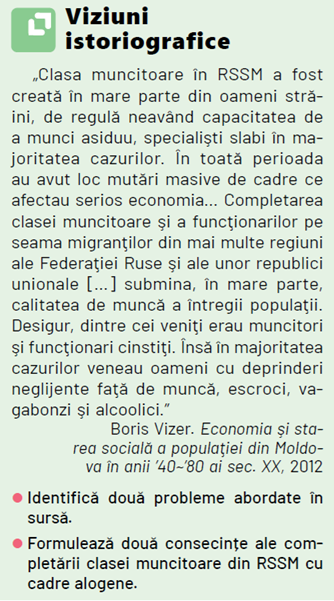
No. 107 Correct answer: This is a tendentious interpretation that does not correspond to the actual demographic processes. During both the imperial Russian and Romanian periods, Moldovans lived predominantly in rural areas. According to the Romanian census of 1930, they accounted for 31.47% of the urban population. Romanians who visited Chișinău during the interwar period were struck by the predominance of the Russian language in the streets. It was precisely during the Soviet period that the mass urbanization of Moldovans began. According to the 1970 census, they made up 35.08% of the urban population of the Moldavian SSR, and by 1989 their share had risen to 46.33%. In support of their biased interpretation, under the heading “Historiographical Views,” the authors cite a xenophobic passage concerning allegedly unwelcome “foreign personnel,” written by a formerly loyal Soviet historian who, after 1991, became an ardent Romanian nationalist: “In most cases, these were people with a negligent attitude toward work, fraudsters, vagrants, and alcoholics” (p. 185).
Всесоюзная перепись населения 1970 года. Городское и сельское население республик СССР по полу и национальности. URL: https://www.demoscope.ru/weekly/ssp/ussr_nac_70.php?reg=9
Всесоюзная перепись населения 1989 года. Распределение городского и сельского населения республик СССР по полу и национальности. URL: https://www.demoscope.ru/weekly/ssp/ussr_nac_89.php?reg=9
Nr. 108 P. 196: „Gorbaciov a încetat să ofere sprijin militar sovietic guvernelor comuniste din Europa de Est și la întâlnirea cu G.W. Bush, din 2–3 decembrie 1989, pe insula Malta, a declarat că nu va folosi forța pentru menținerea regimurilor comuniste în Europa de Est. Această declarație, dar și politica promovată de Gorbaciov au deschis ușa către răsturnarea regimurilor comuniste din țările socialiste din Europa de Est, în 1989”
No. 108 P. 196: "Gorbachev ceased providing Soviet military support to the communist governments of Eastern Europe and, at his meeting with George H. W. Bush on the island of Malta on 2–3 December 1989, declared that he would not use force to preserve the communist regimes in Eastern Europe. This declaration, together with the policies pursued by Gorbachev, opened the way for the overthrow of the communist regimes in the socialist countries of Eastern Europe in 1989."
No. 108 Correct answer: The authors confuse causes with consequences. In Poland, a non-communist government had already been formed on 19 August 1989; in Hungary, communist rule had been dismantled by 23 October 1989; in Bulgaria, communist leader Todor Zhivkov was removed on 10 November 1989; in Czechoslovakia, the Velvet Revolution began on 17 November 1989; and in the German Democratic Republic, the Socialist Unity Party government resigned on 1 December 1989. Only in Romania did Ceaușescu’s regime survive until the Malta Summit. At Malta, Gorbachev effectively did no more than acknowledge the situation that had already emerged and renounce the use of force.
Nr. 109 P. 224: „În 1990, Namibia, o fostă colonie germană, devenită protectorat al Africii de Sud după Primul Război Mondial, a obținut independența”.
No. 109 P. 224: "In 1990, Namibia, a former German colony that had become a South African protectorate after the First World War, gained independence."
No. 109 Correct answer: Namibia was not a protectorate but a mandated territory. A protectorate is a country with its own local government, for example a monarch, but subject to the authority of a colonial power. In this case, in 1920 the League of Nations granted the Union of South Africa a mandate to administer the former German colony pending a final decision on its status. In 1966, the United Nations General Assembly formally terminated the mandate of South Africa, the successor state to the Union of South Africa, and declared its continued presence to be an illegal occupation.
South African Invasion of German South West Africa (Union of South Africa). URL: https://encyclopedia.1914-1918-online.net/article/south-african-invasion-of-german-south-west-africa-union-of-south-africa/
Nr. 110 P. 239: „Deoarece Parlamentul ales la 29 iulie 2009 a fost dizolvat, pe motiv că nu a reuşit alegerea preşedintelui Republicii Moldova, în 2010, în scopul depăşirii crizei consituţionale generate de imposibilitatea alegerii şefului statului prin votul Parlamentului, s-a desfăşurat un referendum privind alegerea preşedintelui republicii prin vot direct, care însă a eşuat”.
No. 110 P. 239: "Since the Parliament elected on 29 July 2009 was dissolved because it had failed to elect the President of the Republic of Moldova, a referendum was held in 2010 on the direct election of the President in an effort to overcome the constitutional crisis resulting from Parliament's inability to elect the Head of State. The referendum, however, failed."
No. 110 Correct answer: The sentence creates the impression that Parliament was dissolved before the referendum on “the issue of electing the President of the Republic by direct vote.” In fact, Parliament was dissolved on 29 September 2010, after the results of the referendum of 5 September 2010 had been declared invalid because of low voter turnout. The turnout threshold was 33.3%, while only 29.67% of eligible voters participated.
Указ о роспуске парламента XVIII созыва официально подписан http://www.evedomosti.md/news/Ukaz_O_Rospuske_Parlamenta_Xviii_Sozyva_Ofitsialno_Podpisan Республиканский конституционный референдум 5 сентября 2010 года http://www.e-democracy.md/ru/elections/referendum/2010/
Nr. 111 P. 253: „Toate drepturile și libertățile prevăzute de Constituție și legislația Republicii Moldova, cu excepția celor prevăzute de legea în cauză, sunt garantate și în Găgăuzia. În pofida avertizării Consiliului Europei, precum că Chişinăul ‘a mers prea departe în satisfacerea cererilor de separatism ale minorităţilor’, Parlamentul Moldovei a acceptat autonomia regională pe principii etnice drept o soluţie specifică, locală”.
No. 111 P. 253: "All rights and freedoms provided for by the Constitution and legislation of the Republic of Moldova, except for those specifically regulated by the law in question, are also guaranteed in Gagauzia. Despite the Council of Europe’s warning that Chișinău had ‘gone too far in accommodating the separatist demands of minorities,’ the Moldovan Parliament accepted regional autonomy based on ethnic principles as a specific local solution."
No. 111 Correct answer: It is unclear where the authors obtained the claim that the Council of Europe warned Chișinău that it had “gone too far in accommodating minority demands for separatism.” On the contrary, Lord Finsberg’s report to the Council of Europe of 22 May 1995 stated that “The Gagauz settlement could serve as a precedent for solving the far more complicated problem of Transnistria. It could even serve as a model for solving similar conflicts in the former Yugoslavia and the former USSR, even the conflict in Chechnya. It is indicative in this respect that Croatia has shown an interest in the text of the law on Gagauzes in view of the situation in the occupied territories ("the Krajina").”
Finsberg G. Report on the Application by Moldova for Membership of the Council of Europe. 22.05.1995. URL: https://assembly.coe.int/nw/xml/XRef/X2H-Xref-ViewHTML.asp?FileID=6851&lang=EN
Nr. 112 P. 261: „Nume de străzi — dovadă a istoriei”.
No. 112 P. 261: "Street Names as Evidence of History."
No. 112 Correct answer: In fact, the present-day Ștefan cel Mare și Sfânt Boulevard underwent many more changes of name. According to the reference work Chișinău: bulevarde, străzi, piețe, parcuri, from the beginning of the nineteenth century it was known as Moskovskaya Street, with the unofficial name Millionnaya also being used; from 1877 it was Alexandrovskaya Street; and from 1924, Alexandru cel Bun Street. In 1931, the street was not renamed in its entirety, as the textbook illustration suggests, but was divided into two sections: from Mareșal Badoglio Street—Marshal Badoglio Street, now Armenian Street—to the railway station, it continued to be called Alexandru cel Bun, while the section from Mareșal Badoglio toward the Sculeni tollgate was renamed Regele Carol II Boulevard. In 1940, the Bolsheviks (!) restored the tsarist name Alexandrovskaya; in 1941, the Romanian authorities restored the division into Alexandru cel Bun Street and Regele Carol II Boulevard; in 1944 it became Lenin Street; in 1952, Lenin Avenue; and since 1990, Ștefan cel Mare și Sfânt Boulevard.
Chişinău: bulevarde, străzi, pieţe, parcuri. Ghid enciclopedic. Chişinău, 2017. P. 275–276.

Nr. 113 P. 264: „La 18 martie 1965, cosmonautul sovietic Aleksei Leonov a ieșit în spațiul cosmic din modulul „Voshod 2” pentru 10 minute”.
No. 113 P. 264: "On 18 March 1965, Soviet cosmonaut Alexei Leonov left the Voskhod 2 spacecraft and spent ten minutes in outer space."
No. 113 Correct answer: The first spacewalk lasted a total of 23 minutes and 41 seconds, of which 12 minutes and 9 seconds were spent outside the spacecraft.
18 March 1965: Leonov Successfully Made the First Spacewalk. URL: https://www.fai.org/news/18-march-1965-leonov-successfully-made-first-spacewalk
Nr. 114 P. 285: „Astfel, Guineea-Bissau a avut un contract în valoare de trei ori mai mare decât venitul national (aproximativ 600 mil. de dolari) pentru depozitarea a 20 mil. de tone de deșeuri pe an. Unele țări, de ex. Senegalul, Beninul, Zairul, depozitează deșeuri extrem de periculoase”.
No. 114 P. 285: "Thus, Guinea-Bissau concluded a contract worth three times its national income—approximately 600 million dollars—for the storage of 20 million tonnes of waste per year. Some countries, including Senegal, Benin, and Zaire, store extremely hazardous waste."
No. 114 Correct answer: (1) The carelessly worded sentence makes it impossible to determine whether the figure of 600 million dollars refers to Guinea-Bissau’s national income or to the value of the contract. In fact, in 1987 the government of Guinea-Bissau received an offer to accept 15 million tonnes of waste at a price of 40 dollars per tonne, for a total of 600 million dollars. However, the contract was not concluded because of pressure from international organizations. (2) The claim that the value of the proposed contract was three times greater than Guinea-Bissau’s national income is also incorrect, since the country’s gross national income in 1987 was approximately 433 million dollars.
Gross National Income for Guinea-Bissau. URL: https://fred.stlouisfed.org/series/MKTGNIGWA646NWDB
Dumping on Africa: West exports its industrial wastes. URL:
Appendix 1. National Institute for the Study of the Holocaust in Romania "Elie Wiesel." 09.04.2025. Observations on the Contents of the 12th Grade Textbook History of the Romanians and World History, Știința Publishing House, 2024.
Lesson 17 – Romania from Democracy to Authoritarianism
p. 81:
“In 1933, the Iron Guard was banned, and the elections held that same year were won by the PNȚ. The tragic event of the assassination of Prime Minister I.G. Duca by the Legionaries triggered the introduction of a state of siege by the PNȚ government.”
The information presented in this paragraph is incorrect. In 1933, the elections were won by the PNL, and it was also the PNL that introduced the state of siege.
p. 81: exercise
Testimonies of Contemporaries
“Today, Friday, 24 June 1927, the Feast of Saint John the Baptist, at ten o’clock in the evening, the Legion of the ‘Archangel Michael’ is hereby established under my leadership. Let those who believe without limit join these ranks. Let those who have doubts remain outside. I appoint Radu Mironovici as head of the guard at the Icon.”
Account by Corneliu Zelea Codreanu
• Identify the type of political organization that was created.• Express your opinion regarding the reasons for the success of the Legionary Movement in Romania.
The exercise entitled “Testimonies of Contemporaries” is based on an inappropriate quotation that is irrelevant to the requirements of the exercise.
p. 83:
“The Legionary Movement found itself in an extremely difficult situation. The Legionary leader, Corneliu Zelea Codreanu, was tried and sentenced first to six months’ imprisonment and then to ten years, and was executed on the night of 29–30 November 1938. In response, on 21 September 1939, a group of Legionaries assassinated Prime Minister Armand Călinescu.”
It was not only the Legionary Movement that was in a difficult situation! All political parties had been dissolved. This paragraph conveys the idea that the assassination of Prime Minister Călinescu was justified.
Lesson 23 – The Second World War. Military Strategies and Actions in the War (1939–1945)*
p. 114:
“At the beginning of 1941, by threatening the use of force, Hitler persuaded Bulgaria, Romania, and Hungary to join the Axis Powers.”
This sentence downplays the status of these states as allies of Nazi Germany. These states retained their sovereignty, and their political and military elites collaborated voluntarily with Nazi Germany.
Lesson 24 – The Year 1940 in the History of the Romanians. The Formation of the Moldavian SSR and the Establishment of the Communist Regime
p. 122: an exercise based on a quotation from a member of the “Majadahonda” group
p. 122:
“In 1940–1941, the population of Bessarabia, especially the intelligentsia and the clergy, refused to collaborate with the occupiers through forms of passive resistance, while the peasants refused to join collective farms. Nevertheless, there were also active, open resistance movements, such as the ‘Majadahonda’ organization, led by a group of young people and adolescents from Orhei, which was harshly suppressed by the NKVD through arrests and death sentences.”
The references to the “Majadahonda” group—the exercise in the “Testimonies of Contemporaries” box and the brief mention in the lesson text—convey a positive attitude toward the organization to the student. We consider this attitude inappropriate, as the meaning of the group’s name carries an ideological significance that indicates a fascist commitment. Majadahonda is the locality where, in 1937, two Legionaries, Ionel Moța and Vasile Marin, died in the Spanish Civil War. They were quickly turned into heroes by Legionary propaganda and were widely used in the ideological symbolism of the Romanian far right. A Legionary monument was erected at Majadahonda, and to this day it remains a gathering place for fascist sympathizers from Romania and Spain.
Lesson 25 – Romania’s Participation in the Second World War: Causes, Events, and Consequences
p. 124: the “Historiographical Perspectives” box
“Antonescu outlawed the National Legionary State, which he and the Guard had established in September 1940 as a military-fascist dictatorship. But his dictatorship differed in many respects from those of his predecessors or his European counterparts. He adopted many of the corporatist guild features that had characterized Carol’s reign. He sought the support of all conservative political groups and responsible Legionaries in the name of a national, anti-communist crusade, in fact one of his own. It should be noted that Antonescu did not claim the Guard’s antisemitic and racist legacy and that he eradicated all manifestations of hooliganism. His reformist tendencies were closer to those of Carol than to those of Codreanu, focusing, although for military purposes, on the modernization of agriculture and industry. His cardinal error, inherent in the very rationale of his dictatorship, was the channeling of the national effort into the military campaign, an anti-communist and anti-Russian campaign. In order to eliminate communism and recover the territories lost to Russia in 1940, he firmly committed Romania to the fatal war against the Soviet Union launched by Hitler in June 1941—which does not mean that Antonescu misjudged the mood in Romania. Antonescu enjoyed the overwhelming support of the Romanian nation for his military activities against the Soviet Union.”
Stephen Fischer-Galați, Romania in the Twentieth Century
The selected passage is unsuitable for a textbook that aims to cultivate civic awareness and democratic values. The author’s positive analysis of Antonescu fails to present the genocidal character of Antonescu’s government and even misrepresents the racist and antisemitic character of the regime: “It should be noted that Antonescu did not claim the Guard’s antisemitic and racist legacy and that he eradicated all manifestations of hooliganism.”
p. 124:
“...During a meeting between them on 6 August, Hitler assigned the Romanian Army the task of launching an offensive toward Odessa and the Crimean Peninsula. Romania was also granted the right to establish its own administration in Transnistria, and I. Antonescu received the rank of marshal.”
This paragraph conveys the message that Hitler imposed the continuation of the war on Antonescu, specifically the offensive toward Odessa. This does not correspond to historical truth! Furthermore, Antonescu did not receive the rank of marshal from Hitler. Antonescu was the commander of the army of a sovereign state. In practice, Antonescu awarded himself the rank of marshal!
p. 125:
The box entitled “Historiographical Perspectives” contains a quotation from Buzatu... but it is not even an analytical quotation; it appears to come from an introduction:
“Not all those who found themselves—so to speak—in the shadow of Marshal Antonescu ‘saw’ him from the same angle or attributed the same impressions to the recorded events. [...] With the observation that we have preferred to introduce the reader to the most important, the most difficult, and the most controversial period in the life and activity of Ion Antonescu—the period during which he served as leader of the Romanian state, consequently imprinting his own pace and convictions on the course of Romanian history, and not only that—we express our conviction that it is preferable to leave the reader sovereign, allowing him to make his own fortunate selection from among the numerous ‘pieces’ or ‘arguments’ for and against that are offered by the extensive, grandiose, and still open ‘Ion Antonescu case file!’”
Gh. Buzatu, Marshal Antonescu before History
• Identify two characteristics of the period discussed in the book.
Gh. Buzatu was one of the most active apologists for Ion Antonescu and a denier of Romanian responsibility for the Holocaust. The selected passage is inappropriate, and the task for students associated with it does not correspond to the text!
Lesson 26 – Bessarabia and Transnistria during the Second World War
p. 128: the box entitled “Historiographical Perspectives”:
“In Bessarabia, the regime of I. Antonescu established itself primarily as an anti-communist one. The internal security forces in Bessarabia, the police and the gendarmerie, arrested persons who had propagated communist ideology, had servilely supported the Bolshevik regime, and had denigrated everything Romanian. The police authorities in Bessarabia worked continuously to identify persons who had publicly acted against the Romanian state, had caused moral and material harm to Romanians who remained under Bolshevik rule, had persecuted them, and had contributed to their execution and deportation through the denunciations they made. Thus, Ivan (Vanea) Brailov, Anton Kuzentsov, Cosovan, Hrișan Gufu, and Gh. Fosteris, employees of the NKVD canteen in Chișinău, were arrested for carrying out intense anti-Romanian and communist activity. The police in Orhei investigated and brought before the Chișinău Court-Martial Agripina Surguci, aged 36, who had worked as a chambermaid at Orhei City Hall under the Soviets. Having friendly relations with the communist Secară, deputy mayor, she supplied her with information about former officials, including the town’s mayor, Plăcintă; the latter were deported by the Soviets to Siberia.”
Anatol Petrencu, Bessarabia during the Second World War
This passage completely omits the mass crimes and deportations committed by the Romanian authorities in the summer and autumn of 1941.
p. 129:
“Although the region [Bessarabia] was not directly subordinated to the central authorities in Bucharest, the national spirit reached this area of Romania during those years. The governors and directors promoted the process of Romanianization of the workforce, directed activity in rural areas toward practical occupations that had previously been associated with foreign elements, granted tax incentives to economic initiatives, and coordinated the interests of employers with those of employees. Efforts were made to identify, inventory, administer, and make use of property that had come into the possession of the state. Colonization was also carried out by attracting young people from other, overpopulated parts of the country to take over properties abandoned by German colonists or to fill places left vacant by the war. The disciplined leadership of the country under Ion Antonescu, with an emphasis on moral cleansing and the competent promotion of personnel, most of whom had distinguished military careers, had a significant positive impact on the development of this region between the Prut and the Dniester during that period. In 1944, Bessarabia once again became a theater of war, with serious consequences for Romania’s territorial integrity.”
This passage distorts a series of realities of Romanian rule in Bessarabia during the war. The use of the phrase “the process of Romanianization,” in the context of presenting the period of the Second World War, is invariably associated with the Romanian state’s policy of confiscating property, dispossessing, and excluding Romanian citizens of Jewish origin from economic and social life. Expressions such as “occupations that had previously been associated with foreign elements” or “to fill places left vacant by the war” conceal the abusive and antisemitic character of the Antonescu regime and obscure its criminal component.
p. 130:
“Although the Romanian element was predominant in Transnistria, Romania could neither have nor claim the right of sovereignty over a territory that had not belonged to it. The Romanian administration concentrated its efforts on restoring and revitalizing economic life in Transnistria. It initially took measures to ensure the supply of food and essential goods to the population and to maintain public order.”
“Although the Romanian element was predominant in Transnistria” — This statement is false!
p. 131:
“The activity of the Romanian administration in Transnistria was overshadowed by crimes connected with the use of Transnistria as a place for the deportation and extermination of Jews and Roma. I. Antonescu pursued a contradictory policy toward the Jewish question; initially he was reserved and did not accept Nazi policies, but gradually, because of pressure, he adopted racial laws, ordered the deportation of Jews and Roma to Transnistria, and cooperation with the Nazis led to numerous victims and the commission of crimes against humanity.”
The flawed wording in the text creates confusion regarding the responsibility of the Romanian authorities for the deportation and death of Jews and Roma. The conclusions of the Final Report of the International Commission on the Holocaust in Romania show that “Direct responsibility for the Holocaust in Romania belongs exclusively to the Romanian state led by Antonescu.” The legislation and measures directed against Jews and Roma were initiatives of the Romanian authorities and were not adopted because of German pressure, as this passage suggests.
Lesson 28 – Crimes against Humanity: the Gulag, the Holocaust, Katyn
p. 143: Manifestations of the Holocaust in Romania.
“In the Kingdom of Romania, the Holocaust began in 1938 with the promulgation of the first restrictive anti-Jewish laws by the Goga government, when more than 220,000 Jews were deprived of a series of political and civil rights; it continued after Romania entered the war, including in the territories controlled by the Romanian state, and ended in 1944. After Romania entered the war, a large number of Jews were deported to camps in Bessarabia and Transnistria. Forty-nine camps and ghettos were established in Bessarabia. The deportation instructions stipulated that ‘Jews who are unable to keep up with the convoys, whether because of weakness or illness, are to be executed.’ Research estimates that the number of Jews deported to camps in Transnistria between 1941 and 1943 ranged from 110,033 people—55,867 from Bessarabia, 43,798 from Bukovina, and 10,368 from the city and county of Dorohoi—to 119,000 people. According to the Final Report of the International Commission on the Holocaust in Romania, at least 15,000 Jews were killed in the Kingdom, in the Iași Pogrom and as a result of other anti-Jewish measures; in Bessarabia and Bukovina in 1941, between 45,000 and 60,000 Jews were killed. Between 105,000 and 120,000 deported Romanian Jews died as a result of the expulsions to Transnistria, while in the Transnistria region, especially in Odessa and the Golta and Berezovca districts, between 115,000 and 180,000 local Jews were killed.”
Throughout the entire paragraph in which the Holocaust in Romania is described in summary form, those responsible are not identified!
p. 143:
“It remains a certainty that the Antonescu regime did not participate in the mass deportation of Jews organized by Nazi officials as part of Hitler’s ‘Final Solution’ to the Jewish question in Europe, due to opposition from public opinion and political leaders. Beginning in December 1942, the deportations practically ceased because the government changed its policy toward the Jews, primarily in response to the deterioration of the military situation on the Eastern Front after the Battle of Stalingrad and as efforts were being made to reach an understanding with the Western Allies.”
The statement of the factual situation—that under the Antonescu regime no Jews from Southern Transylvania or the Old Kingdom were deported to territories controlled by Nazi Germany—is inadequately formulated, leaving the reader with the impression that no deportations took place in Romania. An unambiguous formulation should make it clear that the Antonescu regime pursued its own genocidal policy against the Jews, which involved deportations to Transnistria, while in the case of the Jews from the Old Kingdom and Southern Transylvania, the plans for deportation to Auschwitz-Birkenau developed during the first half of 1942 were halted in October–November 1942.
p. 143: Case Study
“The Holocaust of the Roma in the Romanian Lands.”
“Part of the Holocaust during the Second World War was the Holocaust of the Roma. The first wave of Roma deportations in Romania took place between 25 June and 15 August 1942, when 11,441 ‘nomadic Gypsies’ were deported to Transnistria, including 2,352 men, 2,375 women, and 6,714 children. Between 12 and 20 September 1942, a second wave of deportations followed: 12,176 ‘settled Gypsies’ who had criminal convictions, were repeat offenders, or had no means of supporting themselves. Because of the extremely harsh living conditions in the places of deportation—especially hunger, cold, and disease—approximately 11,000 of the deportees died in Transnistria. In total, 24,617 people suffered, representing 9.38% of those recorded in the 1930 census. The survivors returned to the country in the spring of 1944, when the Romanian army and authorities withdrew from Transnistria. Every year, on 2 August, the Holocaust of the Roma is commemorated internationally.”
Throughout this case study, which provides a summary description of the deportation of the Roma to Transnistria, nothing is said about those responsible.
pp. 143–144: Chapter “Punishment of War Criminals”
Although the textbook covers both the History of the Romanians and World History, this chapter makes no mention of the trial and punishment of war criminals in Romania, despite the fact that the trial of Ion Antonescu and his collaborators occupies a central place in this subject.
Manualul de Istorie de clasa a XII-a din Republica Moldova stârnește criticile comunității evreiești pentru felul „edulcorat” și „inadecvat” în care prezintă regimul Antonescu și elemente ale Holocaustului / Ministrul Dan Perciun: „Nu sunt lucruri dramatice” / Institutul Elie Wiesel insistă că este nevoie de reeditare și corecturi și acuză o „încremenire în proiect”. URL: https://www.edupedu.ro/manualul-de-istorie-de-clasa-a-xii-a-din-republica-moldova-starneste-criticile-comunitatii-evreiesti-pentru-felul-edulcorat-si-inadecvat-in-care-prezinta-regimul-an/
Appendix 2. Yad Vashem, the World Holocaust Remembrance Center. 6 April 2025. Comments of Yad Vashem Experts, Dr. Arkady Zeltzer and Dr. Alexander Avraham, on the Romanian and Universal History Textbook (12th Grade)
Historical Terms:
This textbook presents an overly-simple definition of:
Antisemitism: “hostile attitude (political, social) towards Jews”.
Instead, we recommend using the IHRA definition.
Ghetto: “neighborhood designed exclusively for Jews, who were not permitted to leave it, during the Fascist persecutions in countries occupied by the Nazis (=Hitlerists)”.
There is no reference to the ghettos in a historical perspective.
For example, when defining ghettos, the textbook only mentions those in countries occupied by Germany, and there is no reference to Romania. It is not stated that the 49 ghettos and camps in Bessarabia were created by the Romanian government, or that it was the Romanian authorities who carried out the deportation of residents of Bessarabia and northern Bukovina to Transnistria.
There is no mention of large ghettos like those in Cernowitz in North Bukovina, Chișinău in Bessarabia or Berșhad in Transnistria. The Pechora camp in Transnistria, which some researchers consider a “death camp,” is not mentioned, as well as the camp and murder site in Bogdanovka.
Very broad definition of the Holocaust: “extermination of Jewish, Roma, Polish population, etc., disabled persons, sexual minorities by the Nazis and their allies”; “anti-Jewish actions implemented by the Nazi government and its allies”. The standard “broad” definition includes Roma, disabled persons, sexual minorities; there is no need to stress the “systematic persecution and extermination”.
The definition of the Holocaust in the textbook more closely resembles the modern Russian definition of “genocide of Soviet peoples” rather than the commonly accepted Western understanding of this historical event.
The Holocaust is a broader concept than the direct killing of Jewish people, including the revoking of human rights, destruction of Jewish cultural and spiritual heritage, etc. From the textbook’s definition, students cannot understand that the total destruction of Jews was based on racial criteria, and that the killing of Slavs, especially Poles, was not total, as Slavs were considered a lower race, and not “anti-race” like Jews.
Additionally, the persecution of people with disabilities and sexual minorities was not carried out on racial grounds. The following sentence is also imprecise in this regard:
“The essence of the Nazi idea was the promotion of the superiority of the German Aryan race and xenophobia, antisemitism, which manifested itself not only in the desire to exterminate all Jews in Europe but also in the extermination of other races and peoples, in the pursuit of an aggressive policy of global expansion and world domination.”
Including Poles/Slavs and other victims of Nazi persecution within this definition leads to Holocaust relativization and the Holocaust is presented at parity with the Gulag as well as the Katyn executions, as examples of crimes against humanity. Such complete equalization of two regimes does not correspond to contemporary scholarly views and undermines the basic understanding of the essence of racial Nazi ideology and practice.
Historical Factual Inaccuracies:
Outdated figures are used based on the Encyclopedia Judaica, 1971; this needs to be updated. We suggest consulting Yad Vashem's website and research publications for more up-to-date references.
The textbook states that “Hitler intended to blame the Jews for provoking WWII”, whereas Hitler did actually do so in his Reichstag speech in January 1939.
“If international finance Jewry inside and outside Europe should succeed in plunging the nations once more into a world war, the result will be not the Bolshevization of the earth and thereby the victory of Jewry, but the annihilation of the Jewish race in Europe.”
The textbook mentions only 4 extermination camps: no mention of Chelmno and Majdanek.
The case study for the Holocaust “Righteous among the Nations Irena Sendler Krzyżanowska” states that she founded “Żegota”, which is not true, and “saved and sheltered” 75,000 Polish Jews, including 25,000 Jewish children from the Warsaw ghetto, which exaggerates the actual numbers.
Moreover, why does the case study about the mass murder of Jews focus on the attempt to help by non-Jews rather than centering the actual events of mass murder throughout the Holocaust? This approach raises concerns.
It is also unclear why the textbook for Moldovan students does not present the Righteous among the Nations from Bessarabia or from north Bukovina.
The mention of “Manifestations of the Holocaust in Romania” (1938–1944) should be more accurately listed as: December 1938 – August 1944.
The Goga Government should be the Goga-Cuza Government.
Number of Jews deported to Transnistria is listed as between 110,033 and 119,000 and this figure should be listed instead as 154,000–170,000.
The textbook quotes correctly the Final Report for the number of the victims by regions: 15,000 Old Kingdom and Iași, 45–60,000 in Bukovina and Bessarabia 1941, 105,000–120,000 Romanian Jews as result of deportations to Transnistria [in contradiction with 110,033 and 119,000 deportees above], 115–180,000 Ukrainian Jews in Transnistria.
General Comments:
o For Soviet policy the ethnic criteria became important mainly during World War II with the deportation of Germans, Crimean Tatars, Chechens, and other ethnic groups accused by the regime of collaborating with the Nazis and was not the general characteristic of the regime.
The textbook gives the impression that Soviet anti-religious measures were not general in nature and that Catholics, Jews, and Muslims were not persecuted.
o The textbook could lead one to believe that the Soviet deportations from Bessarabia and northern Bukovina were deportations of ethnic Romanians only. Students may not understand that these repressions were based on political and social criteria rather than ethnic ones. There is no mention of the deported Ukrainians, Russians, or Jews, although research studies show that Jews constituted a third of those deported, meaning their share was twice as high as their percentage in the total population of the Soviet-annexed Romanian territories.
o The textbook uses “killed” but not “mass murder” when referring to Odessa, Golta, Berezovka.
o There are some issues with the case study of The Holocaust of the Roma in the Romanian territory. The textbook notes that 24,600 Roma were murdered, 9.8% of those registered in the 1930 census and mentions the International Day of Commemoration of Roma on 2 August.
o By contrast there is no mention of the percentage of Romanian Jews murdered (~50%) and nothing is listed on the deportation and extermination of the Jews from Northern Transylvania and no mention of the day marking the Holocaust of the Jews on 9 October.
o Moreover, it is unclear why the case study about the Holocaust in Romania focuses on the suffering of the Roma rather than centering the mass murder of Jews.
o When describing Romania's transition from democracy to dictatorship, particular emphasis is placed on foreign policy factors, even more than on the internal political development of the country and the sentiments of the population.
o The reasons for Antonescu's rise to power are reduced to the trauma of the Soviet annexation of Bessarabia and Bukovina in the summer of 1940, and the loss of Romanian territories to Hungary and Bulgaria.
o The political shifts themselves are largely tied to political pressure from Germany and the Romanian extreme right.
o The textbook does not mention that radical Romanian nationalists Octavian Goga and A.C. Cuza, throughout their political careers, adhered to a pronounced antisemitic stance and received direct support from Nazi Germany in the 1930s.
o Nothing is said about the strong anti-Jewish sentiments among the Romanian student youth, many of whom were grouped around the Iron Guard of Codreanu.
o The Iron Guard is mentioned negatively, and it is stated that in 1933 they were outlawed, but there is no mention that in 1938 they became politically active again and even had ministers, and were major partners in Antonescu's government in September 1940. The textbook does not explain that the Iron Guard was an antisemitic Romanian Nazi organization that engaged in the assassination of Romanian political figures or why Hitler finally supported Antonescu rather than the local Nazis.
o Also, students may otherwise remain unaware that such radical groups had significant support among a part of the Romanian population, including young intellectuals.
o Historical Input Regarding Antonescu:
o The textbook completely avoids mentioning the role and responsibility of the Antonescu government in the implementation of the persecution and extermination of the Jews in Romania:
o “a large number of Jews were deported” [by whom?],
o “49 camps and ghettos were created in Bessarabia” [by whom?],
o “the instructions regarding the deportations stipulated...” [by whom?].
o No mention of any responsible Romanian authorities, army, police, gendarmerie, etc.
Regarding Romanian policy in Transnistria, the textbook states:
"The work of the Romanian administration in Transnistria was marred by crimes related to using Transnistria as a place of deportation and suppression of Jews and Roma. I. Antonescu followed a contradictory policy on the Jewish question. Initially, he was restrained and did not approve of the Nazis' policies, but gradually, under pressure, he accepted racial laws, ordered the deportation of Jews and Roma to Transnistria, and his cooperation with the Nazis led to numerous victims and crimes against humanity."
This general statement is all that the textbook offers when describing the role of the Romanian authorities in the Holocaust. Later, these crimes are attributed to nameless forces.
The textbook contains no mention of systematic anti-Jewish legislation, Romanianization or forced labor.
In many parts of the textbook, the impression is created that there is an attempt to downplay the responsibility of the Romanian authorities and population for the implementation of anti-Jewish policies and the Holocaust. Information that could undermine the positive image of the Romanian leadership, and Antonescu personally, is not presented.
Antonescu, who held pronounced antisemitic views and sought ways to deport Jews outside Romania, is presented in the textbook as a rational politician who was forced to comply with Hitler's demands on the Jewish issue.
Antonescu is portrayed as a victim of political circumstances, rather than as a full-fledged ally of Hitler during World War II. Conversely, there is information aimed at creating a positive image of the Romanian authorities.
It is also not stated that the murder of Jews in Odessa was organized on Antonescu's direct orders. The textbook mentions the pogrom in Iași, but there is no mention of pogroms and mass executions in dozens of places in Bessarabia and North Bukovina during the summer of 1941, carried out by Romanian military, gendarmes, and part of the local population.
There are no explanations as to why such a high number of deported and local Jews died during the deportations and later in the ghettos and camps of Transnistria. As a positive counterpoint to this murderous policy, the textbook mentions the fact that the plan for the deportation of Romanian Jews to death camps in Poland, agreed upon with Antonescu's regime, was never carried out. Since this event is presented in such general terms, it creates a completely different perspective on Romanian policy toward Jews:
"It is also undeniable that Antonescu regime did not participate in the mass deportation of Jews, organized by Nazi officials as part of Hitler's 'final solution' to the Jewish question in Europe, due to public opinion and political leaders who opposed it."
After reading the textbook, a student would remain completely unaware of why Jews from Bessarabia and northern Bukovina were deported and killed, but Jews from other regions of Romania were not treated similarly.
The idea of fighting "Judeo-Bolshevism" is attributed only to the Nazi regime.
Anti-Jewish policies implemented by Nazi Germany and its allies perceived "the Jews" not only on racial grounds but also as carriers of what they called the "Jewish Spirit" (Juedischen Geist); this "spirit" being the idea of human equality. Consequently, anti-Jewish policies, which started in the 1930s, consisted not only of the intent to kill all Jews (which started to be implemented from the summer of 1941 in the so-called Final Solution of the Jewish Question), but also of eradicating broader expressions of human equality; one such expression was "Judeo-Bolshevism", which was a leading trope in Eastern Europe. As a result, the persecution of the Jews took on a special dimension among the broader perpetrations carried out by Germany and its allies, including Romania.
There are also a number of potential issues with the following paragraph:
"The fact is certain that the Antonescu regime did not participate to the mass deportation of the Jews that was organized by the Nazi officials within the framework of Hitler's 'Final Solution' of the Jewish problem in Europe, because of the public opinion and the political leaders that were opposed. Beginning with December 1942 the deportations practically ended, because the government changed its policy towards the Jews, first of all in reaction to the deterioration of the military situation on the Eastern front after the battle of Stalingrad and as attempts were made to attain an agreement with the western Allies."
The Antonescu regime bears sole responsibility for the persecution, deportation and extermination of the Jews of Iași, Dorohoi, Bukovina, Bessarabia and Transnistria, but in collaboration and coordination with the Nazi plans for the "Final Solution", as agreed in many common meetings of Romanian and German high-level representatives.
The Antonescu regime did plan and did coordinate together with Nazi high-level representatives the deportation of up to 290,000 Romanian Jews from the Old Kingdom and Southern Transylvania to the extermination camp of Bełżec in September–October 1942.
The planned deportations were indeed halted on 13 October 1942, not December, but not for the reasons stated: the "public opinion" in wartime Romania condoned and in part supported, and sometimes benefited from, the persecution, deportation and murder of Jews. The only "political leaders" that were opposed were those of the muffled opposition parties, namely conservative I. Maniu, liberal C. Brătianu.
The battle of Stalingrad ended in February 1943 and the government's tentative contacts with the Allies started even later, so these could not have determined the halting of the deportations in October 1942. The real reasons for the plans being halted were the pressure of political opposition leaders and other important personalities, the efforts of the Jewish leadership as well as Antonescu's frustration with the German refusal to provide modern equipment and arms to Romanian troops on the Eastern Front and the denial to grant the return of Northern Transylvania to Romania at the war's end. The indispensable role of the Jews in the Romanian war economy was also a concern to the government in addition to these aspects of social or political pressure.
The end of the deportations did not reflect a real change of the government's policy towards the Jews which continued unabated, with much more emphasis on forced labor and ongoing Romanianization.
Comments of Yad Vashem Experts, Dr. Arkady Zeltzer and Dr. Alexander Avraham, on the
Romanian and Universal History Textbook (12th Grade). URL: https://mec.gov.md/sites/default/files/expertixa_manual_de_istorie_yad_vashem.pdf


