
A Textbook of Historical Disinformation? A List of Factual Errors in the Textbook. Part I
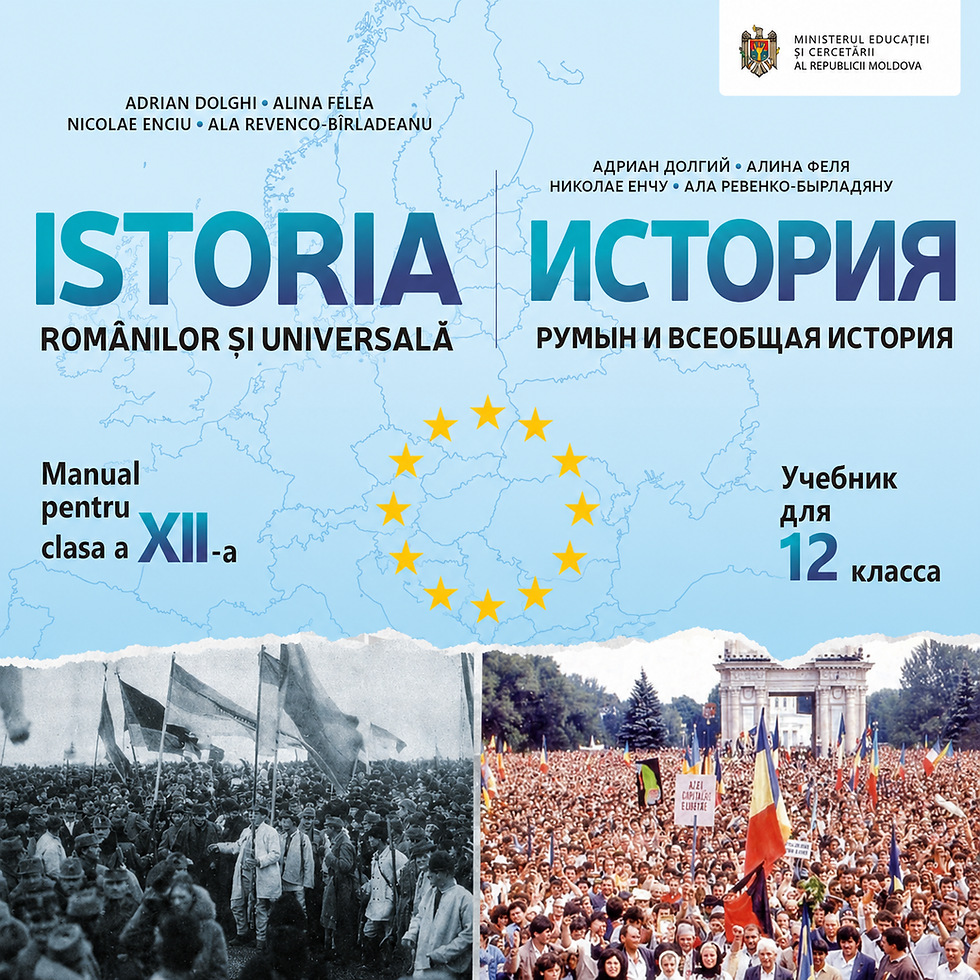
A Textbook of Historical Disinformation? A List of Factual Errors in the Textbook: Istoria românilor şi universală: Manual pentru clasa a 12-a / Adrian Dolghi, Alina Felea, Nicolae Enciu, Ala Revenco-Bîrladeanu; Ministerul Educaţiei şi Cercetării al Republicii Moldova. — [Chişinău]: Ştiinţa, 2024 (Combinatul Poligrafic). — 304 p.: il.
РУССКИЙ: Учебник исторической дезинформации? Список фактических ошибок учебника: История румын и всеобщая история
ROMÂNA: Un manual al dezinformării istorice? Lista erorilor factuale din manual: Istoria românilor şi universală
The Grade 12 textbook History of the Romanians, published in 2024 under the auspices of the Ministry of Education of the Republic of Moldova, has provoked widespread public criticism because of the authors' attempt to normalize the regime of Marshal Antonescu, Hitler's ally, and to marginalize the Romanian Holocaust, in which between 280,000 and 380,000 Jews and approximately 11,000 Roma were murdered.
The textbook received negative evaluations from the Yad Vashem Institute (Jerusalem) and the Elie Wiesel National Institute (Bucharest). The Jewish Community of the Republic of Moldova demanded that the textbook be withdrawn from use in schools and filed a lawsuit against the Ministry of Education.
The Minister of Education, Dan Perciun, has refused to comply with the Jewish Community's demand. On 15 May 2025, he stated that “at this stage, in the opinion of our country's leading historians, there are no problems with the textbook; the overall assessments are positive, while recommendations have been made on how it can be improved.”
The journal Historical Expertise has undertaken the initiative to demonstrate that the textbook is unacceptable not only on ideological grounds but also because it is riddled with serious factual errors. We identified 114 errors of this kind. Students who study from this textbook will not only acquire inaccurate knowledge about the past but may also receive unsatisfactory grades in their examinations.
We address the results of our expert review to everyone concerned with the quality of education in the schools of the Republic of Moldova: parents, teachers, politicians, public figures, and representatives of international organizations. We hope that, through our joint efforts, children will be protected from indoctrination based on an ideology that is questionable from the perspective of European values, coupled with a stream of factual errors that are inconceivable in a school textbook.
Serghei Erlih, PhD, Editor-in-Chief of the journal Historical Expertise;
Leonid Mosionzhnik, PhD;
Alexey Rusanov, Independent Researcher;
Mark Tkachuk, PhD, Member of Parliament of the Republic of Moldova
Alexei Tulbure, Director of Oral History Institute of Moldova
Raport final. Comisia Internaţională pentru Studierea Holocaustului în România. Raport final. Editori: Tuvia Friling, Radu Ioanid, Mihail E. Ionescu. Iaşi: Polirom, 2004. P. 178, 240. URL: https://www.inshr-ew.ro/wp-content/uploads/2026/05/Raport_final.pdf.pdf
Comments of Yad Vashem Experts, Dr. Arkady Zeltzer and Dr. Alexander Avraham, on the
Romanian and Universal History Textbook (12th Grade). URL: https://mec.gov.md/sites/default/files/expertixa_manual_de_istorie_yad_vashem.pdf
Manualul de Istorie de clasa a XII-a din Republica Moldova stârnește criticile comunității evreiești pentru felul „edulcorat” și „inadecvat” în care prezintă regimul Antonescu și elemente ale Holocaustului / Ministrul Dan Perciun: „Nu sunt lucruri dramatice” / Institutul Elie Wiesel insistă că este nevoie de reeditare și corecturi și acuză o „încremenire în proiect”. URL: https://www.edupedu.ro/manualul-de-istorie-de-clasa-a-xii-a-din-republica-moldova-starneste-criticile-comunitatii-evreiesti-pentru-felul-edulcorat-si-inadecvat-in-care-prezinta-regimul-an/
Statement of the Jewish Community of the Republic of Moldova regarding public reports about a meeting of the representatives of “Jewish youth” with the Minister of Education and Research of the Republic of Moldova. URL: https://jcm.md/en/statementof-the-jewish-community-of-the-republic-of-moldovaregarding-public-reports-about-a-meeting-of-the-representatives-of-jewish-youth-with-the-minister-of-education-and-research/
Ministerul Educației a primit răspuns de la Yad Vashem privind manualul de istorie pentru clasa a XII-a. „Multe sugestii acolo”URL: https://tv8.md/2025/05/15/video-ministerul-educatiei-a-primit-raspuns-de-la-yad-vashem-privind-manualul-de-istorie-pentru-clasa-a-xii-a-multe-sugestii-acolo/281577
Contents. Part I:
Contents. Part II:
Other: 32 errors
Appendix 1. National Institute for the Study of the Holocaust in Romania "Elie Wiesel". 09.04.2025. Observations on the Contents of the 12th Grade Textbook History of the Romanians and World History, Știința Publishing House, 2024.
Appendix 2. Yad Vashem, the World Holocaust Remembrance Center. 6 April 2025. Comments of Yad Vashem Experts, Dr. Arkady Zeltzer and Dr. Alexander Avraham, on the Romanian and Universal History Textbook (12th Grade)
Illustrations: 9 errors

Nr. 1 P. 22: Harta „Statele Europei în Primul Război Mondial”.
No. 1 P. 22: Map: "The States of Europe during the First World War."
No. 1 Correct answer: The map contains submarine symbols, but the legend does not explain what they represent. The legend also includes a symbol labelled “First use of poison gas,” yet the map does not identify the city of Ypres, near which poison gas was first used. In addition to the Masurian Lakes, the map also marks a puzzling location designated as “Mazura.”

Nr. 2 P. 26: Harta „România în Primul Război Mondial”.
No. 2 P. 26: Map: "Romania during the First World War."
No. 2 Correct answer: Izmail and Kiliia were not captured by the Central Powers either in the summer of 1917, as indicated on the map, or at any later date. The map does not show that, under the Treaty of Bucharest of 7 May 1918, Austria-Hungary acquired the Carpathian mountain passes. It also indicates that Romania lost the whole of Dobruja under the treaty. In fact, only Southern Dobruja was ceded to Bulgaria, while Northern Dobruja became a condominium under the control of the Central Powers, although it nominally remained part of Romania.

Nr. 3 P. 44: Harta „Europa conform sistemului de tratate de la Versailles”.
No. 3 P. 44: Map: "Europe under the Versailles Treaty System."
No. 3 Correct answer: Part of the territory of East Prussia (the territory of today's Kaliningrad Region of the Russian Federation) has effectively been "submerged" in the sea. Instead, East Prussia is depicted in the area of Toruń and Bydgoszcz, which in fact never belonged to it. Moreover, the borders of the USSR, Poland, Romania, Yugoslavia, Italy, Bulgaria, and Greece are shown not as they were in 1923 (following the final establishment of the Versailles system), but as they stood after the Second World War. In particular, Western Ukraine, Vyborg, and the Moldavian SSR are already shown as Soviet territories; Istria as part of Yugoslavia; and Silesia and Pomerania as parts of Poland.

Nr. 4 P. 72: Harta „Expansiunea Germaniei naziste 1933–1939”.
No. 4 P. 72: Map: "The Expansion of Nazi Germany, 1933–1939."
No. 4 Correct answer: The map, which is intended to represent the 1930s, depicts Germany and Austria-Hungary within their 1914 borders. It is therefore unclear why Alsace-Lorraine and the Polish Corridor are shaded. The Vilnius Region, the Klaipėda Region, and the Saar are also shaded but neither labeled nor explained. In addition, Silesia is mislabeled on the territory of Poznań, while Poznań itself is displaced to the north. Czechoslovakia is labeled but does not include Slovakia.

Nr. 5 P. 112: Harta „Declanșarea și începutul celui de-al Doilea Război Mondial”.
No. 5 P. 112: Map: "The Outbreak and Initial Stage of the Second World War."
No. 5 Correct answer: The map presents not merely the beginning but, in an extremely simplified form, the entire Second World War. Poland is depicted with imaginary borders: it includes Silesia but not Pomerania, while the territory annexed by the USSR in 1939 is shifted to the area where Warsaw and Kraków should be located. Moreover, Poland is colored in a distinctive shade that is not explained in the legend. Slovakia is shown as encompassing the whole of Czechoslovakia (within its 1945 borders). The northern part of East Prussia has disappeared into the sea. Austria was not an independent state during this period: from 1938 to 1945 it was regarded as part of Germany. Istria at that time belonged to Italy, not Yugoslavia. The Axis allies and the countries occupied by the Axis are shown in the same color, making it impossible to distinguish between those that joined the Axis voluntarily and those that did so under coercion. Stalingrad is misplaced near the Ukrainian border. Furthermore, Germany never invaded Finland, let alone through Leningrad.

Nr. 6 P. 126: „B-24 — avioane sovietice în timpul Raidului asupra orașului Ploiești, 1 august 1943”.
No. 6 P. 126: "B-24 — Soviet aircraft during the raid on the city of Ploiești, 1 August 1943."
No. 6 Correct answer: The aircraft clearly display American national insignia. The photograph was taken during Operation Tidal Wave, the Anglo-American air operation carried out on 1 August 1943 to destroy the oil refineries at Ploiești, Romania. The raid involved 178 American B-24 bombers flying from airfields in Libya. The USSR did not participate in this operation.
1943 — Operation Tidalwave, the Low-level bombing of the Ploesti Oil Refineries, 1 August 1943. URL: https://www.afhistory.af.mil/FAQs/Fact-Sheets/Article/459003/1943-operation-tidalwave-the-low-level-bombing-of-the-ploesti-oil-refineries-1/

Nr. 7 P.181: „Îmbarcarea persoanelor deportate în vagoane, Chişinău, 1949”
No. 7 P. 181: "Boarding of Deported Persons into Railway Freight Cars, Chișinău, 1949."
No. 7 Correct answer: In fact, the photograph depicts the deportation of Jews from the Łódź Ghetto to the Chełmno extermination camp.
Jews from the Łódź ghetto board deportation trains for the Chelmno death camp.

Nr. 8 P. 224: Harta „Decolonizarea în Africa”.
No. 8 P. 224: Map: "Decolonization in Africa."
No. 8 Correct answer: The Suez Canal is located farther west than shown on the map. The area between Tanzania, Uganda, and Kenya is occupied not by an unnamed former German colony, but by Lake Victoria.

Nr. 9 P. 235: Harta „Colapsul URSS-ului și al Organizației tratatului de la Varșovia.
№ 9 P. 235: Map: "The Collapse of the USSR and the Warsaw Treaty Organization."
No. 9 Correct answer: Albania was not part of Yugoslavia. In the case of Macedonia, the former Yugoslav republic should be indicated—today officially known as North Macedonia—rather than the Greek region of Macedonia. Nakhchivan, incidentally not “Nakhichevan,” is not an independent state but part of Azerbaijan. The Kaliningrad Region of the Russian Federation is shown as part of the sea. Kyrgyzstan and Tajikistan are depicted outside the borders of the USSR.
Chronology: 34 errors
Nr. 10 P. 12: „Primele corporații transnaționale create la începutul secolului XX au fost General Electric din SUA și AEG (Compania General Electric) din Germania”.
No. 10 P. 12: "The first transnational corporations established at the beginning of the twentieth century were General Electric of the United States and AEG (General Electric Company) of Germany."
No. 10 Correct answer: (1) Both companies were established in the nineteenth century. The American company General Electric (GE) has operated under its current name since 1892, while the German company Allgemeine Elektrizitäts-Gesellschaft (AEG) has borne its current name since 1887. (2) It is incorrect to provide an English expansion of the abbreviation of the German company AEG.
Timeline of General Electric. URL: https://en.wikipedia.org/wiki/Timeline_of_General_Electric#cite_note-4
Nr. 11 P. 18: „Tensiunile în relațiile internaționale s-au intensificat după o serie de crize politico-diplomatice de la începutul secolului XX: rivalitatea franco-germană din Maroc, anexarea Bosniei și Herțegovinei de către Imperiul Austro-Ungar în 1908–1909, dar și Războaiele balcanice din 1912–1913”.
No. 11 P. 18: "Tensions in international relations intensified following a series of political and diplomatic crises in the early twentieth century, including the Franco-German rivalry over Morocco, the annexation of Bosnia and Herzegovina by Austria-Hungary in 1908–1909, and the Balkan Wars of 1912–1913."
No. 11 Correct answer: Austria-Hungary annexed Bosnia and Herzegovina in 1908.
Bosnian crisis of 1908. URL: https://www.britannica.com/event/Bosnian-crisis-of-1908
Nr. 12 P. 27: „Kaizerul Wilhelm a abdicat la 9 noiembrie 1918, astfel sfârșindu-se monarhia germană”.
No. 12 P. 27: "Kaiser Wilhelm abdicated on 9 November 1918, thereby bringing the German monarchy to an end."
No. 12 Correct answer: The Kaiser formally abdicated on 28 November 1918. On 9 November, during the German Revolution, Reich Chancellor Prince Maximilian of Baden announced the Emperor’s abdication without consulting the Kaiser or informing him of the decision.
Abdication of Wilhelm II. URL: https://en.wikipedia.org/wiki/Abdication_of_Wilhelm_II
Nr. 13 P. 27: „În primele luni ale anului 1919, Austria a lichidat instituțiile statului imperial, a proclamat votul general și principalele libertăți democratice”.
No. 13 P. 27: "During the first months of 1919, Austria abolished the institutions of the imperial state and proclaimed universal suffrage together with the fundamental democratic freedoms."
No. 13 Correct answer: Universal suffrage in the Austrian half of the Dual Monarchy of Austria-Hungary was introduced in 1907. The fundamental democratic freedoms in the Austrian part of the Empire were established by the December Constitution of 1867.
December Constitution. URL: https://en.wikipedia.org/wiki/December_Constitution#cite_note-rgbl142-2
Election Law, Austrian. URL: https://www.cambridge.org/core/journals/american-political-science-review/article/abs/election-law-austrian/C6CB407097408ED5476C540C8B64FDFB
Nr. 14 P. 98: „În vederea sincronizării proceselor politice, economice, administrative a fost adoptat calendarul gregorian (stilul nou) pe întreg cuprinsul ţării, ziua de 1 aprilie 1919, pe stil vechi, devenind 15 aprilie — stil nou”.
No. 14 P. 98: "In order to synchronize political, economic, and administrative processes, the Gregorian calendar (New Style) was adopted throughout the country, with 1 April 1919 (Old Style) becoming 15 April (New Style)."
No. 14 Correct answer: During the twentieth and twenty-first centuries, the difference between the Old Style (Julian) and New Style (Gregorian) calendars amounts to 13 days. Therefore, 1 April 1919 (Old Style) corresponds to 14 April 1919 (New Style).
Nr. 15 P. 102: „Numește județele Bucovinei și ale Basarabiei conform reformei administrative din anul 1928”.
No. 15 P. 102: "Name the counties of Bukovina and Bessarabia in accordance with the administrative reform of 1928."
No. 15 Correct answer: The administrative reform in Romania took place in 1925.
LEGE nr. 95 din 13 iunie 1925 pentru Unificarea Administrativă. URL: https://legislatie.just.ro/public/DetaliiDocument/107203
Nr. 16 P. 115: „La 29 martie 1944, trupele sovietice au ocupat orașul Cernăuți, ajungând până la râul Prut, și au declanșat „Operația Iași–Chișinău””.
No. 16 P. 115: "On 29 March 1944, Soviet troops occupied the city of Chernivtsi, advanced to the Prut River, and launched the Iași–Chișinău Operation."
No. 16 Correct answer: The phrase “and began” implies that the Jassy–Kishinev Offensive started immediately after Soviet forces reached the Prut River and captured Chernivtsi on 29 March 1944 during the Proskurov–Chernivtsi Offensive. In fact, the Jassy–Kishinev Offensive began much later—on 20 August 1944, almost five months after the Red Army reached the Prut. Referring to the events of 8 April–6 June 1944 as the “First Jassy–Kishinev Offensive” is extremely rare and is disputed by specialists.
Liddell Hart B. H. History of the Second World War. London: Pan Books, 1970. P. 573; Earl F. Ziemke. Stalingrad to Berlin: The German Defeat in the East. Washington, D.C.: Center of Military History, U.S. Army, 1968 (repr. 1987). P. 350.
Nr. 17 P. 116: „La mijlocul lunii decembrie 1944, trupele sovietice au pătruns pe teritoriul german”.
No. 17 P. 116: "By the middle of December 1944, Soviet troops had entered German territory."
No. 17 Correct answer: Soviet troops entered German territory on three occasions, but not in December 1944: (1) the first Soviet unit tactically crossed the German frontier on 17 August 1944 along the East Prussian border northwest of Vilkaviškis: "one platoon... crossed the border and for the first time brought the war onto German soil." (2) on 16 October 1944, Red Army forces entered German territory along a broad front in East Prussia and (3) the large-scale offensive on German territory began in January 1945 during the Vistula–Oder and East Prussian offensives.
Earl F. Ziemke. Stalingrad to Berlin: The German Defeat in the East. Washington, D.C.: Center of Military History, U.S. Army, 1968 (repr. 1987). P. 343, 409, 421–424.
Nr. 18 P. 116: „În ciuda rezistenței acerbe a inamicului, la 12 aprilie 1945, trupele sovietice au inițiat asaltul Berlinului”.
No. 18 P. 116: "Despite fierce enemy resistance, on 12 April 1945 Soviet troops launched the assault on Berlin."
No. 18 Correct answer: The Berlin Strategic Offensive Operation, which resulted in the capture of Berlin, began on 16 April 1945.
Earl F. Ziemke. Stalingrad to Berlin: The German Defeat in the East. Washington, D.C.: Center of Military History, U.S. Army, 1968 (repr. 1987). P. 474.
Nr. 19 P. 116: „Luptele pentru insulele japoneze Iwo Jima și Okinawa, în februarie–aprilie 1945, au fost complicate; pentru a captura o insulă, americanii au luptat 1-2 luni”.
No. 19 P. 116: "The battles for the Japanese islands of Iwo Jima and Okinawa, fought between February and April 1945, were particularly difficult; the Americans required one to two months to capture each island."
No. 19 Correct answer: In fact, the fighting for the two islands extended from February through June 1945. The Battle of Okinawa lasted nearly three months, from 1 April to 22 June 1945.
Garand, G. W., Strobridge, T. R. History of U.S. Marine Corps Operations in World War II. Vol. IV: Western Pacific Operations. Washington, D.C.: Historical Branch, HQ U.S. Marine Corps. P. 762–763. Appleman, R. E., Burns, J. M., Gugeler, R. A., Stevens, J. Okinawa: The Last Battle. (U.S. Army in World War II: The War in the Pacific). Washington, D.C.: Center of Military History, U.S. Army, 1948 (repr.). P. 69, 470.
Nr. 20 P. 117: „În contextul desfășurării Celui de-Al Doilea Război Mondial în Europa, al capitulării Franței, la 22 iunie 1940, al pregătirii de invadare a Marii Britanii de către Germania, al invadării Greciei de trupe italiene și germane și al pretențiilor teritoriale ale Ungariei și Bulgariei, la 26 iunie 1940, V. Molotov i-a remis o notă ultimativă ambasadorului român la Moscova, Gh. Davidescu, în care se cerea ca România să cedeze Basarabia».
No. 20 P. 117: "Against the backdrop of the Second World War in Europe, the capitulation of France on 22 June 1940, Germany's preparations for the invasion of Great Britain, the invasion of Greece by Italian and German forces, and the territorial claims advanced by Hungary and Bulgaria, on 26 June 1940 Vyacheslav Molotov presented an ultimatum to the Romanian ambassador in Moscow, Gheorghe Davidescu, demanding that Romania cede Bessarabia."
No. 20 Correct answer: The poorly worded sentence creates the false impression that the Italian and German invasion of Greece began before 26 June 1940. In fact, Italy invaded Greece on 28 October 1940, while Germany joined the campaign on 6 April 1941.
S. O. Playfair et al. The Mediterranean and Middle East. Vol. I: The Early Successes against Italy (to May 1941). London: HMSO, 1954. P. 225, 227. URL: https://www.ibiblio.org/hyperwar/UN/UK/UK-Med-I/UK-Med-I-12.html;
Greece and Crete 1941. In: The Second World War, 1939–1945. A Popular Military History by Christopher Buckley. London: HMSO, 1952. P. 37. URL: https://archive.org/details/greece-crete-1941-buckley.
Nr. 21 P. 125: „2) Operațiuni militare desfășurate între 23 și 31 august 1944 pe teritoriul propriu, cu scopul de a îndepărta trupele germano-fasciste inamice din țară”.
No. 21 P. 125: "2) Military operations conducted between 23 and 31 August 1944 on Romanian territory with the objective of expelling the enemy German and Fascist forces from the country."
No. 21 Correct answer: Following the coup of 23 August 1944, Germany declared war on Romania, and the Wehrmacht began military operations against its former ally. Romania's last remaining territories—the cities of Carei and Satu Mare—were liberated from Hungarian and German control on 25 October 1944.
Battle of Carei. URL: https://en.wikipedia.org/wiki/Battle_of_Carei
Nr. 22 P. 126: „Demonstrează argumentat că România, conform Armistițiului din aprilie 1944, practic a fost lăsată de aliați la discreția URSS-ului”.
No. 22 P. 126: "Provide a reasoned demonstration that, under the Armistice of April 1944, Romania was effectively left by the Allies at the discretion of the USSR."
No. 22 Correct answer: Romania concluded its armistice with the United Nations not in April but on 12 September 1944.
The Armistice Agreement with Rumania; September 12, 1944. URL: https://avalon.law.yale.edu/wwii/rumania.asp
Nr. 23 P. 126: „Restabilirea frontierei româno-sovietice de la 28 iunie 1941».
No. 23 P. 126: "The restoration of the Romanian–Soviet frontier as of 28 June 1941."
No. 23 Correct answer: The textbook contains an error regarding a well-established date: the Soviet annexation of Bessarabia and Northern Bukovina began on 28 June 1940.
Nr. 24 P. 145: „Al Doilea Război Mondial, care a durat șase ani și jumătate, pe parcursul a 2 174 de zile, a fost o perioadă sumbră din istoria umanității”.
No. 24 P. 145: "The Second World War, which lasted six and a half years, spanning 2,174 days, was one of the darkest periods in the history of humanity."
No. 24 Correct answer: The Second World War began on 1 September 1939, with Germany’s invasion of Poland, and ended on 2 September 1945, with the signing of Japan’s instrument of surrender. It therefore lasted six years, or 2,193 days.
Nr. 25 P. 165: „Armata lui Castro a folosit războiul de gherilă, reușind la 3 ianuarie 1959 să ia sub control Havana”
No. 25 P. 165: "Castro's forces employed guerrilla warfare and succeeded in taking control of Havana on 3 January 1959."
No. 25 Correct answer: The rebel forces entered Havana on 1 January 1959.
Nr. 26 P. 168: „1956-1960 — al șaselea plan cincinal. 1961-1965 — al șaptelea plan cincinal”.
No. 26 P. 168: "1956–1960 — the Sixth Five-Year Plan. 1961–1965 — the Seventh Five-Year Plan."
No. 26 Correct answer: The Sixth Five-Year Plan was not completed. Instead, a Seven-Year Plan was adopted for the period 1959–1965.
Seven-Year Plan. URL: https://www.encyclopedia.com/history/encyclopedias-almanacs-transcripts-and-maps/seven-year-plan
Nr. 27 P. 168: „1991, 31 decembrie — destrămarea URSS”.
No. 27 P. 168: "31 December 1991 — the dissolution of the USSR."
No. 27 Correct answer: The USSR officially ceased to exist on 26 December 1991, when the Declaration of the Soviet of the Republics of the Supreme Soviet of the USSR in connection with the establishment of the Commonwealth of Independent States, No. 142-N of 26 December 1991, was adopted. The same error is repeated on p. 172.
Dissolution of the Soviet Union. URL: https://en.wikipedia.org/wiki/Dissolution_of_the_Soviet_Union
Декларация Совета Республик ВС СССР от 26.12.1991 № 142-Н. URL: https://ru.wikisource.org/wiki/%D0%94%D0%B5%D0%BA%D0%BB%D0%B0%D1%80%D0%B0%D1%86%D0%B8%D1%8F_%D0%A1%D0%BE%D0%B2%D0%B5%D1%82%D0%B0_%D0%A0%D0%B5%D1%81%D0%BF%D1%83%D0%B1%D0%BB%D0%B8%D0%BA_%D0%92%D0%A1_%D0%A1%D0%A1%D0%A1%D0%A0_%D0%BE%D1%82_26.12.1991_%E2%84%96_142-%D0%9D
Nr. 28 P. 238: „În noiembrie 1996, președinte al Republicii Moldova a fost ales Petru Lucinschi”.
No. 28 P. 238: "In November 1996, Petru Lucinschi was elected President of the Republic of Moldova."
No. 28 Correct answer: Petru Lucinschi became President after winning the second round of the presidential election, held on 1 December 1996. He assumed office on 15 January 1997.
Alegeri prezidenţiale 1996. URL: http://www.parties.e-democracy.md/electionresults/1996presidential/
Nr. 29 P. 240: „Primul document oficial de instituire a noilor instrumente juridice, economice și funcționale a fost Hotărârea Sovietului Suprem nr. 186, din 25 iunie 1990, ‘Cu privire la concepția trecerii la economia de piață în RSS Moldova’”.
No. 29 P. 240: "The first official document establishing the new legal, economic, and institutional mechanisms was Supreme Soviet Resolution No. 186 of 25 June 1990, ‘On the Concept of the Transition to a Market Economy in the Moldavian SSR’."
No. 29 Correct answer: The resolution was adopted on 25 July 1990.
Marcel Revenco. Începuturile activităţii comerciale externe a Republicii Moldova: cadrul instituţional şi legislative // Akademos 1/2020. P. 108. http://old.akademos.asm.md/files/1_20_103-109.pdf
Nr. 30 P. 245: „La 20 iunie 1992, două regimente ale Armatei Republicii Moldova, sub conducerea colonelului L. Carasev, au intrat în Bender (Tighina) și au luat sub supraveghere podul de pe Nistru”.
No. 30 P. 245: "On 20 June 1992, two regiments of the Armed Forces of the Republic of Moldova, under the command of Colonel L. Carasev, entered Bender (Tighina) and took control of the bridge over the Dniester."
No. 30 Correct answer: The deployment of Moldovan armed forces into Bender began on 19 June 1992. Colonel Leonid Karasev commanded only one of several tactical groups of the Moldovan army, namely a battalion, which had been assigned the task of taking control of Bender.
Gilles-Emmanuel Jacquet. Histoire du conflit moldo-transnistrien. Editions Publibook, 2017. P. 293–294.
Nr. 31 P. 248: „1 iunie 1996 — începutul activității Casei Naționalităților/Biroul Relații Interetnice”.
No. 31 P. 248: "1 June 1996 — the commencement of the activities of the House of Nationalities/Bureau for Interethnic Relations."
No. 31 Correct answer: The parliamentary resolution establishing the institution that was successively known as the State Department for Nationality Issues of the Republic of Moldova (from 1991), the Department of National Relations (from 1994), the Department of National Relations and the Functioning of Languages (1998), the Department of Interethnic Relations (from 2001), the Bureau of Interethnic Relations (from 2005), and the Agency for Interethnic Relations (from 2018) is dated 14 November 1990. The government resolution formally establishing the Department and defining its responsibilities and staffing structure was signed on 25 April 1991.
Scurt istoric https://www.bri.gov.md/ro/content/scurt-istoric
Nr. 32 P. 255: „14 iulie 1995 — Republica Moldova a devenit membru al Consiliului Europei”.
No. 32 P. 255: "14 July 1995 — the Republic of Moldova became a member of the Council of Europe."
No. 32 Correct answer: The Republic of Moldova became a member of the Council of Europe on 13 July 1995.
Aderarea Republicii Moldova la Consiliul Europei https://mfa.gov.md/ro/content/aderarea-republicii-moldova-la-consiliul-europei
Nr. 33 P. 256: „După deteriorarea în câteva rânduri a relaţiilor Republicii Moldova cu Federaţia Rusă, după refuzul preşedintelui V. Voronin de a semna Memorandumul „Kozakˮ în 2003, în 2005 au fost introduse interdicţii la exportul de vinuri din republică spre Rusia”.
No. 33 P. 256: "Following repeated deteriorations in relations between the Republic of Moldova and the Russian Federation, and after President Vladimir Voronin refused to sign the ‘Kozak Memorandum’ in 2003, restrictions were imposed in 2005 on wine exports from the republic to Russia."
No. 33 Correct answer: The embargo on the import of wine products from the Republic of Moldova into the Russian Federation was imposed by Rospotrebnadzor on 27 March 2006.
Агентство Moldova-Vin затрудняется назвать потери виноделов от запрета экспорта вин в Россию https://point.md/ru/novosti/ekonomika/agentstvo-moldova-vin-zatrudnyaetsya-nazvatj-poteri-vinodelov-ot-zapreta-eksporta-vin-v-rossiyu/
«Политические ингредиенты» в молдавском вине неудобоваримы для России https://www.svoboda.org/a/265228.html
Nr. 34 P. 263: „1937 — construcția primului calculator programabil”.
No. 34 P. 263: "1937 — the construction of the first programmable computer."
No. 34 Correct answer: The authors are referring to the computing device developed by the German engineer Konrad Zuse (see p. 265). Its first version, the Z1, was created in 1938. However, the Z3, which Zuse constructed in 1941, is generally regarded as the first fully operational programmable computer.
Z3 (computer). URL: https://en.wikipedia.org/wiki/Z3_(computer)
Nr. 35 P. 263: „1939 — realizarea primului avion cu reacție”.
No. 35 P. 263: "1939 — the development of the first jet aircraft."
No. 35 Correct answer: The prehistory of jet aircraft began before 1939. Surprisingly, the authors of the textbook History of the Romanians appear to be unaware that the Coandă-1910 jet aircraft, designed by the Romanian aeronautical engineer Henri Coandă, was presented at the Second International Aeronautical Exhibition (Paris, 1910). Aviation historians continue to debate whether this aircraft ever actually flew. The first generally recognized jet-powered flight (3.5 km in 75 seconds), performed by the Opel RAK.1, designed by the German engineer Julius Hatry, took place on 30 September 1929 in Frankfurt am Main.
Coandă-1910. URL: https://en.wikipedia.org/wiki/Coand%C4%83-1910
Opel RAK.1. URL: https://en.wikipedia.org/wiki/Opel_RAK.1
Nr. 36 P. 263: „1949 — construcția televizorului în culori”.
No. 36 P. 263: "1949 — the construction of the colour television set."
No. 36 Correct answer: The history of color television broadcasting began before 1949. On 3 July 1928, the British engineer John Logie Baird demonstrated the world’s first color transmission system using mechanical television technology. In 1939, he demonstrated a color television set based on a cathode-ray tube. On 16 August 1944, Baird demonstrated the first fully electronic color display.
John Logie Baird. URL: https://en.wikipedia.org/wiki/John_Logie_Baird
Nr. 37 P. 263: „1951 — intrarea în funcție a primului reactor atomic producător de energie electrică în SUA”.
No. 37 P. 263: "1951 — the first nuclear reactor producing electricity became operational in the United States."
No. 37 Correct answer: On 20 December 1951, during an experiment, the EBR-I reactor near Arco, Idaho, United States, generated usable electricity with an output of only (!) 800 watts. Thus, this was not industrial-scale power generation. It would therefore also be appropriate to mention that on 3 September 1948, electrical appliances in the United States were powered for the first time by electricity generated by the X-10 graphite reactor. The world’s first nuclear power plant connected to an electrical grid was the Obninsk Nuclear Power Plant, which entered commercial operation on 26 June 1954.
Experimental Breeder Reactor-I. URL: https://inl.gov/ebr/
History of NPPs. URL: https://www.nuclear-power.com/nuclear-power-plant/history-nuclear-power-plants/
From Obninsk Beyond: Nuclear Power Conference Looks to Future. URL: https://www.iaea.org/newscenter/news/obninsk-beyond-nuclear-power-conference-looks-future
Nr. 38 P. 264: „Cercetările au continuat, culminând cu crearea bombei H (1952), apoi a bombei cu neutroni (1980)”.
No. 38 P. 264: "Research continued, culminating in the development of the hydrogen bomb in 1952 and subsequently the neutron bomb in 1980."
No. 38 Correct answer: The inventor of the neutron bomb, the American nuclear physicist Samuel Cohen, proposed the concept in 1958. The first tests were conducted in 1962 at an underground test site in Nevada. The bomb entered production in 1974.
Neutron bomb. URL: https://en.wikipedia.org/wiki/Neutron_bomb
Nr. 39 P. 264: „Tot sovieticii au fost cei care, la 17 septembrie 1959, au atins Luna cu satelitul ‘Luna 2’”.
No. 39 P. 264: "It was also the Soviets who, on 17 September 1959, reached the Moon with the Luna 2 spacecraft."
No. 39 Correct answer: Luna 2 reached the surface of the Moon on 13 September 1959.
60 Years Ago: Luna 2 Makes Impact in Moon Race. URL: https://www.nasa.gov/history/60-years-ago-luna-2-makes-impact-in-moon-race/
Nr. 40 P. 264: „În 1999, europenii au pus în funcție cel mai puternic telescop din lume, prin care Universul poate fi cercetat până la o distanță de 12 mld. de ani-lumină”.
No. 40 P. 264: "In 1999, Europeans brought into operation the world’s most powerful telescope, capable of observing the Universe at distances of up to 12 billion light-years."
No. 40 Correct answer: The world’s largest complex consisting of four separate 8.2-meter optical telescopes and four auxiliary 1.8-meter telescopes combined into a single system is known as the Very Large Telescope. It is located at the Paranal Observatory, which belongs to the European Southern Observatory and is situated on Cerro Paranal in Chile at an altitude of 2,635 meters. The first of the four main telescopes entered service in May 1998. The other three were completed in 1999 and 2000.
Very Large Telescope. The world's most advanced visible-light astronomical observatory. URL: https://www.eso.org/public/teles-instr/paranal-observatory/vlt/
Nr. 41 P. 265: „După cel de-Al Doilea Război Mondial, crearea noilor mijloace de investigare (microscopul electronic în 1965, scanerul în 1968, ecograful în 1979) a permis progresul în domeniul cunoașterii materiei vii și fixarea mai precisă a diagnosticelor”.
No. 41 P. 265: "After the Second World War, the development of new investigative technologies—the electron microscope in 1965, the scanner in 1968, and the ultrasound machine in 1979—facilitated progress in the study of living matter and enabled more accurate diagnoses."
No. 41 Correct answer: The first experiments involving ultrasound scanning for medical purposes began in the 1940s. The British researchers Ian Donald and Tom Brown are generally credited with developing the first device to achieve practical clinical use, the Diasonograph, in 1958.
History of the Ultrasound Machine in Obstetrics and Gynecology https://academic-med-surg.scholasticahq.com/article/115458-history-of-the-ultrasound-machine-in-obstetrics-and-gynecology
Nr. 42 P. 265: „Reușita unei experiențe de clonare efectuată pe un mamifer (oaia Dolly, 1997) a deschis drumul unor noi tehnici de reproducere nesexuală”.
No. 42 P. 265: "The successful cloning of a mammal—Dolly the sheep, in 1997—opened the way for new techniques of asexual reproduction."
No. 42 Correct answer: Dolly the sheep was born in the United Kingdom on 5 July 1996.
Dolly (sheep). URL: https://en.wikipedia.org/wiki/Dolly_(sheep)
Nr. 43 P. 265: „În 1942, în SUA a fost construit primul calculator electronic,
ENIAC, cu o suprafață de amplasare de 135 m²”.
No. 43 P. 265: "In 1942, the first electronic computer, ENIAC, was constructed in the United States, occupying an area of 135 square metres."
No. 43 Correct answer: The ENIAC (Electronic Numerical Integrator and Computer), built in the years 1943 to 1946, is widely regarded as the first general-purpose electronic digital computer.
ENIAC. URL: https://ethw.org/ENIAC
Nr. 44 P. 268: „În domeniul fizicii s-a remarcat Ştefan Procopiu, care a creat magnetonul (1912), redescoperit, în mod independent, în 1915 de N. Bohr, căruia i s-a acordat prioritatea descoperirii ‘magnetonului Bohr–Procopiu’”.
No. 44 P. 268: "In the field of physics, Ștefan Procopiu distinguished himself through his formulation of the magneton in 1912, which was independently rediscovered in 1915 by Niels Bohr, to whom priority was accorded in the discovery of what became known as the Bohr–Procopiu magneton."
No. 44 Correct answer: The magneton, or elementary magnetic moment, was first identified and calculated by Procopiu in 1911–1913. Bohr did the same in 1913.
Bohr magneton. URL: https://en.wikipedia.org/wiki/Bohr_magneton
Nr. 45 P. 285: „Problemele demografice s-au aflat în centrul discuțiilor la diferite conferințe, de exemplu, Conferința de la Cairo despre Populație și Dezvoltare, care a avut ca problematică ‘Fonduri pentru populația Națiunilor Unite’, 6–13 septembrie 1994”.
No. 45 P. 285: "Demographic issues were at the centre of discussions at various conferences, including the Cairo Conference on Population and Development, held on 6–13 September 1994, which addressed issues relating to the United Nations Population Fund."
No. 45 Correct answer: The conference took place from 5 to 13 September 1994.
Report of the International Conference on Population and Development, Cairo, 5-13 September 1994. URL: https://www.refworld.org/reference/themreport/unfpa/1995/68255
Statistics and Other Quantitative Indicators: 15 errors
Nr. 46 P. 130: „Deși elementul românesc era preponderent în Transnistria, România nu putea avea și nici nu pretindea dreptul de suveranitate asupra unui teritoriu care nu-i aparținuse”.
No. 46 P. 130: "Although the Romanian ethnic element predominated in Transnistria, Romania could neither possess nor claim sovereign rights over a territory that had never belonged to it."
No. 46 Correct answer: According to the 1941 Romanian census of Transnistria, the "Romanian element" (including Moldovans who did not identify themselves as Romanians) accounted for 8.5% of the province's population.
Transnistria harta etnica. Institutul Central de Statistică, Populația Transnistriei după originea etnică pe județe, medii și orașe (rezultatele inventarierii Transnistriei din 1941), Arhivele MAE, Fond. Conferința Păcii, Paris 1946, vol. 125, f.472. URL: https://commons.wikimedia.org/wiki/File:Transnistria_harta_etnica_1941.jpg#metadata
Nr. 47 P. 136: „Cele 42 de state, care au semnat Declarația Națiunilor Unite și au declarat război Germaniei, au primit o invitație de a participa la lucrările conferinței [în San Francisco]”.
No. 47 P. 136: "The forty-two states that had signed the Declaration by United Nations and declared war on Germany were invited to participate in the proceedings of the Conference [in San Francisco]."
No. 47 Correct answer: On 26 June 1945, representatives of 50 states signed the Charter of the United Nations in San Francisco.
The San Francisco Conference. URL: https://www.un.org/en/about-us/history-of-the-un/san-francisco-conference
Nr 48 P. 143: „În cadrul Procesului de la Nürnberg (20 noiembrie 1945–1 octombrie 1946) au fost identificate și examinate acte de agresiune comise împotriva a 12 ţări (Cehoslovacia, Polonia, Danemarca, Norvegia, Belgia, Olanda, Franţa, Luxemburg, Iugoslavia, Grecia, URSS, SUA)”.
No. 48 P. 143: "During the Nuremberg Trial (20 November 1945–1 October 1946), acts of aggression committed against twelve countries (Czechoslovakia, Poland, Denmark, Norway, Belgium, the Netherlands, France, Luxembourg, Yugoslavia, Greece, the USSR, and the United States) were identified and examined."
No. 48 Correct answer: The United States was not listed in the Nuremberg Indictment as a victim of German armed aggression. The Indictment identified the following states as victims of Germany's wars of aggression: "in violation of international law, treaties and agreements, in the planning, preparation, initiation and waging of aggressive wars against various countries, namely: Poland, the USSR, France, the Netherlands, Belgium, Norway, Denmark, Yugoslavia, Greece, Luxembourg, and Czechoslovakia."
Международный военный трибунал. Нюрнбергский процесс: Сборник материалов: в 8 т. Т. 1. М.: Госюриздат, 1957. С. 53–54.
Nr. 49 P. 216: „Dosarele est-germane redeschise în 1992 au relevat că din 109 persoane ucise în întreaga Germanie de Est 41 au fost soldați sovietici executați pentru refuzul de a trage asupra nemților care protestau”.
No. 49 P. 216: "East German files reopened in 1992 revealed that, of the 109 people killed throughout East Germany, 41 were Soviet soldiers executed for refusing to fire on German demonstrators."
No. 49 Correct answer: This refers to the events in East Germany (GDR) in June 1953. Although this information has become widely known, there are doubts about its reliability not only in Russia (which would be understandable), but also in Germany.
Hans Halter. Die Legende von den toten Russen. URL: https://www.spiegel.de/politik/deutschland/volksaufstand-vom-17-juni-1953-die-legende-von-den-toten-russen-a-253126.html
Nr. 50 P. 241: „În 1991, Republica Moldova avea aproximativ 4,3 mil. de locuitori, în 2000 a ajuns la aproximativ 4 mil., iar în 2020 la circa 2,6–2,7 mil”.
No. 50 P. 241: "In 1991, the Republic of Moldova had a population of approximately 4.3 million; by 2000, it had declined to around 4 million, and by 2020 to approximately 2.6–2.7 million."
No. 50 Correct answer: It is unclear why the authors provide questionable estimates when precise census data are available. According to the 1989 census, the Moldavian SSR had a population of 4.338 million. According to the censuses of the Republic of Moldova, excluding the unrecognized Transnistrian region, the population was 3.388 million in 2004, 2.998 million in 2014, and 2.401 million in 2024.
Nr. 51 P. 263: „Programul spațial „Apollo” a costat 24 mld. de dolari”.
No. 51 P. 263: "The Apollo space programme cost 24 billion dollars."
No. 51 Correct answer: Expenditure on the Apollo program was 25.8 billion dollars. An Improved Cost Analysis of the Apollo Program. URL: https://ui.adsabs.harvard.edu/abs/2022SpPol..6001476D/abstract
Nr. 52 P. 284: „Poluarea apei se referă la contaminarea acesteia cu deșeuri provenite din activitatea industrială și utilizarea chimicalelor în agricultură, dar și la managementul utilizării apei, ținând cont și de faptul că în țările dezvoltate circa 1 mld. de oameni au probleme cu obținerea apei potabile”.
No. 52 P. 284: "Water pollution refers to the contamination of water by waste generated through industrial activity and by the use of chemicals in agriculture, as well as to the management of water use, taking into account the fact that approximately one billion people in developed countries experience difficulties in obtaining safe drinking water."
No. 52 Correct answer: (1) This is an obvious typographical error that misleads students. The correct wording is: în țările în curs de dezvoltare / “in developing countries.” (2) According to the WHO and UNICEF, 2.1 billion people worldwide still lack access to safely managed drinking water.
Fast facts: 1 in 4 people globally still lack access to safe drinking water — WHO, UNICEF https://www.unicef.org/moldova/en/press-releases/fast-facts-1-4-people-globally-still-lack-access-safe-drinking-water-who-unicef
Nr. 53 P. 285: „În 1950, populația mondială era de 2,7 mld. de locuitori, în 1990 — de 5,3 mld., iar în prezent a depășit cifra de 7 mld”.
No. 53 P. 285: "In 1950, the world population stood at 2.7 billion; in 1990, it reached 5.3 billion; and at present it has exceeded 7 billion."
No. 53 Correct answer: Since the textbook is intended for long-term use, it would have been more appropriate to specify the year instead of using the word “today.” Moreover, since the textbook was approved for publication by the Ministry on 11 June 2024 (see p. 2), the authors could, had they wished, have used population data from the 2022, when the world’s population had already exceeded 8 billion.
As the World's Population Surpasses 8 Billion, What Are the Implications for Planetary Health and Sustainability? URL: https://www.un.org/en/un-chronicle/world-population-surpasses-8-billion-what-are-implications-planetary-health-and
Nr. 54 P. 285: „Demografia mondială este dominată de ponderea Asiei cu peste 3,5 mld. de locuitori, pe o cincime din suprafața terestră”.
No. 54 P. 285: "Global demographic patterns are dominated by Asia, which has a population of more than 3.5 billion living on one-fifth of the Earth’s land surface."
No. 54 Correct answer: In 2023, the population of Asia exceeded 4.778 billion.
Asia. 2023. URL: https://www.populationpyramid.net/asia/2023/
Nr. 55 P. 285: „Europa, mai slab populată (530 mil.), are, în schimb, o populație care crește cu doar 0,22% pe an”.
No. 55 P. 285: "Europe, which is less densely populated, with 530 million inhabitants, has a population that grows by only 0.22 per cent per year."
No. 55 Correct answer: In 2023, the population of Europe exceeded 745 million. Since 2021, Europe’s population has been declining rather than growing.
Europe. 2023. URL: https://www.populationpyramid.net/europe/2023/ Europe Population (1950–2026). URL: https://www.worldometers.info/world-population/europe-population/
Nr. 56 P. 286: „Conform UNICEF, în fiecare zi, în medie, în întreaga lume mor peste 26 000 de copii cu vârste sub cinci ani, în general din cauze care pot fi prevenite”.
No. 56 P. 286: "According to UNICEF, more than 26,000 children under the age of five die worldwide every day, on average, primarily from preventable causes."Nr. 117 Răspuns corect: Potrivit UNICEF, în 2023 au murit în întreaga lume 4,8 milioane de copii cu vârsta sub cinci ani, adică aproximativ 13.500 pe zi.
No. 56 Correct answer: According to UNICEF, 4.8 million children under the age of five died worldwide in 2023, equivalent to approximately 13,500 deaths per day.
Levels and trends in child mortality. URL: https://data.unicef.org/resources/levels-and-trends-in-child-mortality-2024/
Nr. 57 P. 286: „Problema sănătății rezultă din alte probleme globale: sărăcia, subnutriția și alimentarea incorectă, ecologia etc., lipsa accesului la sistemele naționale de sănătate pentru 1 miliard de oameni din lume”.
No. 57 P. 286: "The global health problem arises from other worldwide challenges, including poverty, undernutrition, inadequate nutrition, and environmental degradation, as well as the lack of access to national healthcare systems for one billion people worldwide."
No. 57 Correct answer: According to WHO, in 2021 approximately 4.5 billion people—more than half of the world’s population—were unable to access the full range of essential health services.
Billions left behind on the path to universal health coverage. URL: https://www.who.int/news/item/18-09-2023-billions-left-behind-on-the-path-to-universal-health-coverage
Nr. 58 P. 286: „Datele statistice relevante la nivel global (actualizate până în septembrie 2022) atestă: peste 200 mil. de cazuri confirmate de COVID-19; peste 4 mil. de decese cauzate de COVID-19”.
No. 58 P. 286: "Relevant global statistical data, updated through September 2022, indicate more than 200 million confirmed cases of COVID-19 and more than 4 million deaths caused by the disease."
No. 58 Correct answer: According to WHO data, the number of deaths in 2020–2021 exceeded the statistically expected level by 14.9 million.
14.9 million excess deaths associated with the COVID-19 pandemic in 2020 and 2021. URL: https://www.who.int/news/item/05-05-2022-14.9-million-excess-deaths-were-associated-with-the-covid-19-pandemic-in-2020-and-2021
Nr. 59 P. 287: „Pentru necesități militare, suma a depășit 1 trilion de dolari în an, ce reprezintă circa 6–7% din PIB-ul global”.
No. 59 P. 287: "Annual expenditure on military needs exceeded one trillion dollars, representing approximately 6–7 per cent of global GDP."
No. 59 Correct answer: Total global military expenditure exceeded 1 trillion dollars as early as 2004. According to the Stockholm International Peace Research Institute, worldwide military spending in 2023 amounted to 2.443 trillion dollars, approximately 2.5% of global GDP.
Military expenditure. URL: https://www.sipri.org/yearbook/2005/08 Global military spending surges amid war, rising tensions and insecurity. URL: https://www.sipri.org/media/press-release/2024/global-military-spending-surges-amid-war-rising-tensions-and-insecurity
Trends in World Military Expenditure, 2023. URL: https://www.sipri.org/sites/default/files/2024-04/2404_fs_milex_2023.pdf
Nr. 60 P. 287: „Armele nucleare sunt prezente în 6 țări într-o cantitate suficientă pentru a distruge viața pe Pământ de câteva zeci de ori”.
No. 60 P. 287: "Nuclear weapons are possessed by six countries in quantities sufficient to destroy life on Earth several dozen times over."
No. 60 Correct answer: Nine countries possess nuclear weapons: Russia, the United States, the United Kingdom, France, China, Israel, India, Pakistan, and North Korea.
Which countries have nuclear weapons? URL : https://www.icanw.org/nuclear_arsenals
Nr. 61 P. 287: „Conflictele militare care au avut loc din 1945 până la sfârșitul secolului XX au făcut 10 mil. de jertfe”.
No. 61 P. 287: "Military conflicts that occurred between 1945 and the end of the twentieth century resulted in 10 million casualties."
No. 61 Correct answer: The number of military personnel killed in these conflicts alone exceeded 11 million. The number of civilian victims of armed conflicts during this period was considerably higher. In the Korean War of 1950–1953, for example, approximately 800,000 military personnel and around 2 million civilians were killed.
The Economics of Conflict and Peace. URL: https://eolss.net/Sample-Chapters/C13/E1-20-36.pdf
Deane, Hugh. The Korean War: 1945-1953. China Books & Periodicals, 1999. P. 149. URL: https://books.google.md/books?id=XMJpnYmKNQsC&dq=%22korean+war%22+casualties+20%25+population&pg=PA149&redir_esc=y#v=onepage&q&f=false
Nr. 62 P. 288: „În fiecare an, mai ales în țările în curs de dezvoltare, mor de foame aproximativ 18 mil. de oameni”.
No. 62 P. 288: "Every year, approximately 18 million people die from hunger, particularly in developing countries."
No. 62 Correct answer: According to 2021 data from the United Nations World Food Program, an average of 9 million people worldwide die from hunger each year.
In world of wealth, 9 million people die every year from hunger, WFP Chief tells Food System Summit. URL: https://www.wfp.org/news/world-wealth-9-million-people-die-every-year-hunger-wfp-chief-tells-food-system-summit
Nr. 63 P. 288: „Procesul de defrișare a pădurilor în ultimii 10 ani a dus la scăderea suprafeței împădurite cu 35%”.
No. 63 P. 288: "Deforestation over the past ten years has resulted in a 35 per cent reduction in forested areas."
No. 63 Correct answer: According to the Food and Agriculture Organization, the world’s forests covered 4.14 billion hectares in 2025. Globally, 10.9 million hectares are deforested each year; over ten years, this amounts to 109 million hectares, equivalent to a reduction in global forest cover of approximately 2.6%.
Global deforestation slows, but forests remain under pressure, FAO report shows. URL: https://www.fao.org/newsroom/detail/global-deforestation-slows--but-forests-remain-under-pressure--fao-report-shows/en
Nr. 64 P. 289: „În conformitate cu datele agenţiilor ONU, organizaţiei UNAIDS, anual în lume se înregistrează: 33,4 mil. de persoane care trăiesc cu HIV, 2.7 mil. nou-infectate cu HIV, 2 mil. morți de SIDA”.
No. 64 P. 289: "According to data from United Nations agencies and UNAIDS, the following figures are recorded worldwide each year: 33.4 million people living with HIV, 2.7 million newly infected with HIV, and 2 million deaths from AIDS."
No. 64 Correct answer: The textbook presents statistics that are approximately twenty years out of date. According to 2025 data from the United Nations agency UNAIDS, there are 40.9 million people living with HIV worldwide, 1.2 million new HIV infections, and 570,000 AIDS-related deaths per year.
Global HIV & AIDS statistics — Fact sheet. URL: https://www.unaids.org/en/resources/fact-sheet
Nr. 65 P. 290: „În 2023, populația globului a depășit pragul de 7 mld., ceea ce reprezintă o creștere semnificativă, fiind de peste două ori mai mare decât acum o jumătate de secol”.
No. 65 P. 290: "In 2023, the world population exceeded the threshold of 7 billion, representing a significant increase and amounting to more than twice the population recorded half a century earlier."
No. 65 Correct answer: According to United Nations data, the world's population surpassed the 7 billion mark in 2011 and the 8 billion mark in 2022.
Day of 7 Billion. URL: https://web.archive.org/web/20131102064713/http://www.unfpa.org/public/home/news/events/pid/8533
As the World's Population Surpasses 8 Billion, What Are the Implications for Planetary Health and Sustainability? URL: https://www.un.org/en/un-chronicle/world-population-surpasses-8-billion-what-are-implications-planetary-health-and
Nr. 66 P. 290: „Proiecțiile pe termen lung ale ONU estimează o creștere a populației globului la 8,3 mld. de persoane în 2050”.
No. 66 P. 290: "Long-term United Nations projections estimate that the world population will increase to 8.3 billion by 2050."
No. 66 Correct answer: According to the United Nations, the world’s population will increase to 9.8 billion by 2050.
World population projected to reach 9.8 billion in 2050, and 11.2 billion in 2100. URL: https://www.un.org/en/desa/world-population-projected-reach-98-billion-2050-and-112-billion-2100
Nr. 67: „Conform cerinţelor stabilite de Ministerul Educaţiei din Japonia, fiecare elev trebuie să stăpânească cel puţin 1 850 de hieroglife”.
No. 67 P. 295: "Under the requirements established by Japan’s Ministry of Education, every pupil is expected to master at least 1,850 kanji characters."
No. 67 Correct answer: Under the requirements established by Japan’s Ministry of Education in 2010, every student must master at least 2,136 kanji characters. The figure of 1,850 kanji characters was the minimum established in 1946.
Jōyō kanji. URL: https://en.wikipedia.org/wiki/J%C5%8Dy%C5%8D_kanji
Definitions and Logical Inconsistencies: 22 errors
№ 68 P. 27: „La 16 noiembrie 1918 a fost proclamată Republica Ungară. Puterea politică a fost preluată de Consiliul Național, alcătuit din liberali și conservatori, în frunte cu Mihály Karoly. S-a constituit un regim monarhic constituțional-democratic”.
№ 68 P. 27: "On 16 November 1918, the Hungarian Republic was proclaimed. Political power was assumed by the National Council, composed of liberals and conservatives and headed by Mihály Károlyi. A constitutional-democratic monarchical regime was established."
No. 68 Correct answer: The textbook authors have a problem with logic. During the First Republic (16 November 1918 — 21 March 1919), officially known as the Hungarian People's Republic, there could not have existed a "monarchical constitutional-democratic regime."
№ 69 P. 74: „Conceptul totalitarism a fost introdus de Hannah Arendt în lucrarea Originile totalitarismului (1951), pentru a defini regimurile antidemocratice din secolul XX”.
№ 69 P. 74: "The concept of totalitarianism was introduced by Hannah Arendt in her work The Origins of Totalitarianism (1951) to define the anti-democratic regimes of the twentieth century."
No. 69 Correct answer: The term "totalitarianism" was coined in 1923 by the Italian journalist Giovanni Amendola to characterize Benito Mussolini's regime. In 1925, it was adopted by the Italian philosopher and Fascist theorist Giovanni Gentile.
Totalitarianism. URL: https://grokipedia.com/page/Totalitarianism
№ 70 P. 99: „Refacerea economică a țării a durat din 1918 până în 1923. În ce privește căile de dezvoltare a țării, s-au conturat două concepții de politică economică: politica „prin noi înșine”, promovată de PNL și burghezia financiară-liberală, ce urmărea dezvoltarea economică prin forțe proprii, fără a exclude participarea capitalurilor străine; și politica „porților deschise”, promovată de Partidul Național-Țărănesc, de burghezia sătească, de o parte a burgheziei industriale din Transilvania și Banat, legată de capitalurile germane și austro-ungare, ce urmărea ca, prin acordarea unor concesii capitalurilor străine, să se obțină piețe mai avantajoase pentru cerealele românești”.
№ 70 P. 99: "The country's economic recovery lasted from 1918 to 1923. With regard to the country's development strategy, two concepts of economic policy emerged: the ‘By Ourselves’ policy, promoted by the National Liberal Party (PNL) and the financial-liberal bourgeoisie, which sought economic development through domestic resources while not excluding the participation of foreign capital; and the ‘Open Doors’ policy, promoted by the National Peasants' Party, the rural bourgeoisie, and part of the industrial bourgeoisie of Transylvania and Banat, which was linked to German and Austro-Hungarian capital and sought, through concessions to foreign capital, to secure more favorable markets for Romanian grain."
No. 70 Correct answer: The Austro-Hungarian Empire ceased to exist in 1918. Therefore, it is incorrect to refer to "Austro-Hungarian capital" during the period from 1918 to 1923.
№ 71 P. 150: „Cunoaște și înțelege! Studiază sursele A-B și realizează sarcinile propuse”.
№ 71 P. 150: "Know and Understand! Study Sources A–B and complete the assigned tasks."
No. 71 Correct answer: The textbook authors appear not to know or understand the meaning of the term “source,” since the quotations they cite from works by Anatol Petrencu and Andrew Roberts belong, according to the conventions of historical scholarship, not to primary sources but to historiography.
№ 72 P. 168: „Cosmopolitism — concepție potrivit căreia patria e lumea întreagă, iar omul, cetățean al ei; admirație manifestată față de tot ce este străin”.
№ 72 P. 168: "Cosmopolitanism — the doctrine according to which the entire world is one's homeland and every individual is a citizen of it; admiration for everything that is foreign."
No. 72 Correct answer: Paradoxically, the authors effectively reproduce the late Stalinist formula of “servility toward the West,” a period when opponents were branded as “cosmopolitans,” a label that could lead to repression.
Soviet Union in The U.S.S.R. from the death of Lenin to the death of Stalin. URL: https://www.britannica.com/place/Soviet-Union/Into-the-war-1940-45
№ 73 P. 168: „Stalinism — sistem politic autoritar în URSS, care s-a caracterizat prin regimul absolutist de putere personală a lui Iosif Stalin, sistem de comandă-administrativ, întărirea excesivă a funcțiilor represive ale statului, fuziunea organelor de partid și de stat, controlul asupra tuturor aspectelor societății, încălcarea drepturilor și libertăților fundamentale ale omului”.
№ 73 P. 168: "Stalinism — an authoritarian political system in the USSR characterized by Joseph Stalin's absolute personal rule, a command-administrative system, the excessive strengthening of the state's repressive functions, the fusion of Party and state institutions, control over all aspects of society, and the violation of fundamental human rights and freedoms."
No. 73 Correct answer: The authors contradict themselves, since on the preceding pages they classify communist regimes as totalitarian. In particular, Soviet totalitarianism is mentioned on p. 161, in the same section.
№ 74 P. 178–179: „Astfel, inclusiv după 1944 a rămas în vigoare reîmpărțirea teritorial-administrativă a Basarabiei înfăptuită de sovietici în 1940, teritoriul RSSM era de 33,7 mii km², determinat în limitele frontierelor din 1940. Procedând astfel, Moscova și-a ușurat obiectivul rusificării populației băștinașe, aruncând, în același timp, în spiritul conduitei comune oricărui imperiu — „divide et impera” — sămânța discordiei între români și ucraineni”.
№ 74 P. 178–179: "Thus, even after 1944, the territorial-administrative division of Bessarabia introduced by the Soviet authorities in 1940 remained in force. The territory of the Moldavian SSR covered 33.7 thousand km², corresponding to the borders established in 1940. In this way, Moscow facilitated its objective of Russifying the indigenous population while, in accordance with the imperial principle of divide et impera, sowing discord between Romanians and Ukrainians."
No. 74 Correct answer: The logic of this argument is flawed. Drawing the border along ethnic lines resulted in Moldovans forming a decisive majority—approximately two-thirds—of the population of the Moldavian SSR, which could only have made Russification more difficult rather than easier.
№ 75 P. 202: „Ideile de unificare europeană au apărut după Primul Război Mondial, constituirea unei federaţii europene fiind propusă, în 1922, de Rihard Coudenhove-Kalergi”.
№ 75 P. 202: "Ideas of European unification emerged after the First World War, and the creation of a European federation was proposed in 1922 by Richard Coudenhove-Kalergi."
No. 75 Correct answer: This idea emerged long before the end of the First World War. Henry IV had already advanced such a proposal shortly before 1610. It was later restated, with reference to his predecessor, by the Abbé de Saint-Pierre in his Project for Perpetual Peace in Europe (1713); in this work, the proposed future confederation was for the first time called a European Union (Union Européenne). In 1693, William Penn, the founder of Pennsylvania, published An Essay towards the Present and Future Peace of Europe by the Establishment of a European Diet, Parliament, or Estates. In Perpetual Peace (1795), Kant explicitly identified the Abbé de Saint-Pierre as one of his predecessors. By the early twentieth century, such projects were being discussed so actively that Lenin issued a special rebuttal entitled On the Slogan for a United States of Europe (1915).
№ 76 P. 219: Dicționar istoric: „Națiune — comunitate umană caracterizată prin unitatea de teritoriu, conștiința identității istorice și cultură, prin unitatea de limbă și religie”.
№ 76 P. 219: "Nation — a human community characterized by the unity of territory, a shared historical identity and culture, and the unity of language and religion."
No. 76 Correct answer: The authors provide only a definition of the ethnic nation, which closely resembles the definition proposed by such an “expert” on the national question as Stalin: “A nation is a historically constituted, stable community of people, formed on the basis of a common language, territory, economic life, and psychological make-up manifested in a common culture.” Such an understanding of the nation is liable to generate ethnic conflict and is unacceptable in modern liberal democracies, where the political nation is regarded as the norm. What matters in such a nation is not unity of language or religion, but common citizenship and equal rights regardless of ethnic origin or religious affiliation.
№ 77 P. 219: Dicționar istoric: „Rezistență — mișcare populară anticomunistă, antisovietică”.
№ 77 P. 219: Historical Dictionary: "Resistance — a popular anti-communist and anti-Soviet movement."
No. 77 Correct answer: This is a narrow definition that does not correspond to the historical facts. In its modern sense, the term “Resistance” emerged during the Second World War in European countries occupied by the Axis powers, above all in France, and referred to all anti-fascist forces, among which the communists played an important role.
№ 78 P. 238: „Deși a inclus o formulare falsă referitoare la limba de stat, numind-o ‘limba moldovenească’ (art. 13), adoptarea Constituției a reprezentat un pas crucial în consacrarea democrației liberale, a statului de drept și a drepturilor, libertăților și responsabilităților fundamentale ale cetățenilor, contribuind la admiterea Republicii Moldova în rândul statelor membre ale Consiliului Europei”.
№ 78 P. 238: "Although it included what was described as an erroneous formulation concerning the state language, referring to it as the ‘Moldovan language’ (Article 13), the adoption of the Constitution represented a crucial step in consolidating liberal democracy, the rule of law, and the fundamental rights, freedoms, and responsibilities of citizens, contributing to the admission of the Republic of Moldova to membership in the Council of Europe."
No. 78 Correct answer: The authors’ primordialist assumptions prevent them from understanding an obvious point: the name of a language belongs not to the realm of science but to that of politics. A well-known joke among linguists states that “a language is a dialect with an army and a navy.” As long as Yugoslavia existed, there was a single Serbo-Croatian language. Today, the independent states of Bosnia and Herzegovina, Serbia, Croatia, and Montenegro recognize four languages: Bosnian, Serbian, Croatian, and Montenegrin. Other examples include Macedonian and Bulgarian; Danish and Norwegian Bokmål; Czech and Slovak; and so forth.
№ 79 P. 248: „În Republica Moldova, pe lângă populația majoritară românească, de circa 82%, care se identifică fie români, fie moldoveni, locuiesc și minorități entice”.
№ 79 P. 248: "In the Republic of Moldova, alongside the Romanian majority population, which accounts for approximately 82 per cent and identifies either as Romanian or Moldovan, there are also ethnic minorities."
No. 79 Correct answer: The authors interpret the census data tendentiously by combining those who identify as Moldovans and those who identify as Romanians into a single category of “Romanian population.” In doing so, they disregard the self-identification of 77.2% of the citizens of the Republic of Moldova who, according to the 2024 census, identified themselves as Moldovans, whereas only 7.9% identified themselves as Romanians.
№ 80 P. 266: „Reprezentanţii pozitivismului logic (K. Popper, L. Wittgenstein, R. Carnap etc.) considerau că obiectul filosofiei este şi trebuie să rămână analiza logică a ştiinţei și pledau pentru reconcilierea, împăcarea filosofiei cu ştiinţa, susţinând principiul noncontradicţiei”.
№ 80 P. 266: "Representatives of logical positivism, including K. Popper, L. Wittgenstein, and R. Carnap, maintained that the subject matter of philosophy was, and should remain, the logical analysis of science. They advocated the reconciliation of philosophy with science and upheld the principle of non-contradiction."
No. 80 Correct answer: Karl Popper was not a representative of the school of logical positivism, but one of its critics. He is usually classified as a post-positivist.
Postpositivism. URL: https://en.wikipedia.org/wiki/Postpositivism
№ 81 P. 266: „H. Günther, Alfred Rosenberg, Oswald Spengler au fondat Teoria rasei superioare ariene, ierarhizarea şi subordonarea popoarelor pe criterii rasiste, tratarea discriminatorie a indivizilor şi raselor, ce a cunoscut o afirmare pregnantă în Germania interbelică”.
№ 81 P. 266: "Hans Günther, Alfred Rosenberg, and Oswald Spengler developed the theory of a superior Aryan race, which promoted the hierarchical classification and subordination of peoples on racial grounds and the discriminatory treatment of individuals and racial groups, and which gained particular prominence in interwar Germany."
No. 81 Correct answer: Oswald Spengler did not support the “theory of Aryan racial supremacy.” The Nazis failed to win him over to their side. It is therefore incorrect to place him alongside Nazi theorists Hans Günther and Alfred Rosenberg.
Oswald Spengler facts for kids. URL: https://kids.kiddle.co/Oswald_Spengler
№ 82 P. 266: „Structuralismul a fost promovat de R. Jakobson, Noam Chomsky și de istoricul A. Toynbee, care a propus o structură de reguli ce puteau conduce la explicarea modului cum apar, se dezvoltă, înfloresc şi se prăbuşesc civilizaţiile. G. Ryle, în Conceptul spiritului (1949), şi J. Austin, în Sens şi sensibilitate (1962), au extins structuralismul la studiul filosofiei, lingvisticii şi la întreg ansamblul gândirii logice, ca o modalitate de a descoperi sensul adevărat al lucrurilor”.
№ 82 P. 266: "Structuralism was advanced by R. Jakobson, Noam Chomsky, and the historian A. Toynbee, who proposed a system of rules intended to explain how civilizations emerge, develop, flourish, and decline. G. Ryle, in The Concept of Mind (1949), and J. Austin, in Sense and Sensibilia (1962), extended structuralism to the study of philosophy, linguistics, and the broader sphere of logical thought as a means of discovering the true meaning of things."
No. 82 Correct answer: ) The British historian Arnold Joseph Toynbee and the British representatives of the ordinary language philosophy school, Gilbert Ryle and John Austin, had no connection with structuralism. Structuralism is generally regarded as having been founded by Ferdinand de Saussure, with Roman Jakobson, Claude Lévi-Strauss, Vladimir Propp, Roland Barthes, Yuri Lotman, and others among its leading representatives. 2) Translating the title of John Austin’s book Sense and Sensibilia as Sense and Sensibility is misleading because that is the established English title of the famous nineteenth-century novel by Jane Austen, while Sense and Sensibilia is a different work altogether. 3) Arnold J. Toynbee’s middle name, Joseph, should not be omitted, as this creates confusion with his uncle, the prominent economist Arnold Toynbee.


